Wednesday, February 5, 2014

Baahubali all set to create a VFX splash


Loaded with VFX splendor, Rajamouli's film promises to be a visual extravaganza on an unprecedented scale. Director SS Rajamouli's Baahubali is set to create a new benchmark for visual effects in Indian cinema. The film promises to be a visual effects extravaganza with over 4,500 VFX shots. This is a new record in Indian cinema, surpassing the likes of Shah Rukh Khan's Ra.One and Hrithik Roshan's Krishh 3.

Set in an imaginary medieval realm, the film is loaded with computer generated imagery that promises to blur the lines between real and imaginary. Producer Shobu Yarlagadda reckons the movie will be a 'technical marvel'. "We want to offer the audience a real visual spectacle and have been working in that direction from the outset. It's a period drama that will transport the audience into a world of ancient forts, palaces, epic war sequences and the works. The VFX is going to be the most crucial element in the movie. We have the best national and international experts working on the film," says Shobu.

Srinivas Mohan is working as the VFX supervisor for the movie which has a slew of internationally renowned VFX artistes. Some of the visual effects are being done locally while some are being outsourced to foreign technicians around he world. Considering the scale and quality of the VFX work, the film is tipped to have the highest budget for VFX in Indian cinema.

Buzz is that the budget of the film is a staggering `100 crore. However, Shobu gets a little cagey when talking about the budget. "I cannot comment on that since I don't know about the budgets of other films. It is a very expensive film," he says.

Starring Prabhas, Rana, Anushka and Tamannaah in lead roles, the film is set for a 2015 release across all South Indian languages.


Friday, December 20, 2013

Monday, December 2, 2013

Shah Rukh Khan's Red Chillies VFX likely to work on Salman Khan’s 'Kick'

Srk
 
 
Ever since the release of Krrish 3, Shah Rukh Khan's Red Chillies VFX has been garnering a lot of appreciation for their visual effects in the super-hero flick. Thus, it won't be surprising, if the company is brought on board for several other films as well. Buzz is that Red Chillies VFX may work on Salman Khan's Kick, though there's no confirmation on this front as of now. This Salman Khan starrer film helmed by Sajid Nadiadwala has been in news for a while, it is currently in midst of a marathon shooting schedule in Panvel.
Now with there being a minute possibility of Salman Khan and Shah Rukh Khan working together in a film, at least Kick would be instrumental in getting them together offscreen at least. As of now though, Salman is shuffling between the shoot of Kick and Sohail Khan's Jai Ho. In the meanwhile, Red Chilies VFX, is working on Farah Khan's Happy New Year as well.

Friday, November 8, 2013

NUKE 8 is coming: here’s what you need to know

A new version of The Foundry’s flagship product will be shipping in 2013, with the company announcing at IBC that NUKE 8 is set for launch later this year. The Foundry’s timeline tool for NUKE, HIERO, will also be upgraded to version 1.8 this year.
fxguide speaks exclusively to NUKE Product Manager Jon Wadelton about the changes – see below. But first, just what are the main upgrades in NUKE 8?
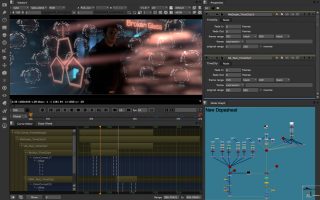
Dope Sheet – artists will be able to see and move keys around in the context of a timeline style view. They will be able to see the results and each property of a node accurately displayed in context. The Foundry says the new viewing capability will make working with any scripts that involve time manipulation a much more simple process
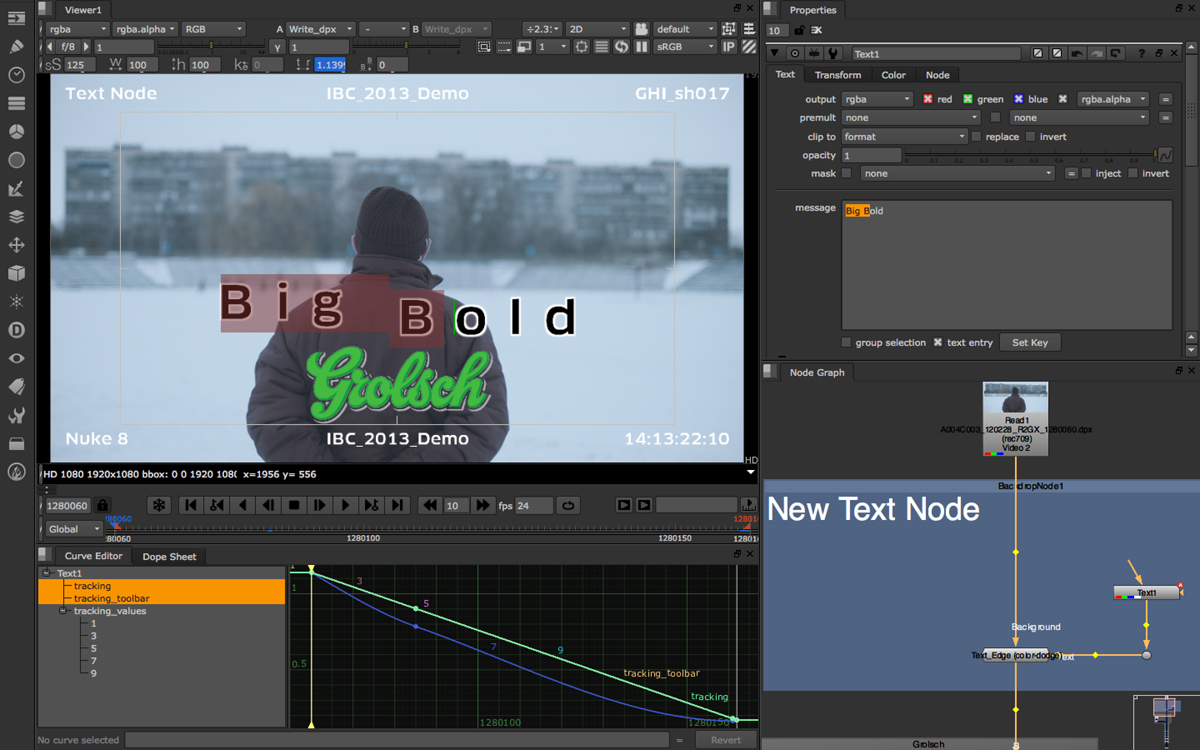
New Text node – lets artists compose, edit and animate directly in the viewer.
Color grading and correction – the NUKE UI has been updated to include an in-panel color wheel to control hue, saturation and value, with an automatic precision mode or optional absolute mode for finer tweaking. There’ll also be a new Pixel Analyser and a Match Grade node.
New scope tools – can be used to analyse the picture like Waveform, Vectorscope and Histogram viewers.
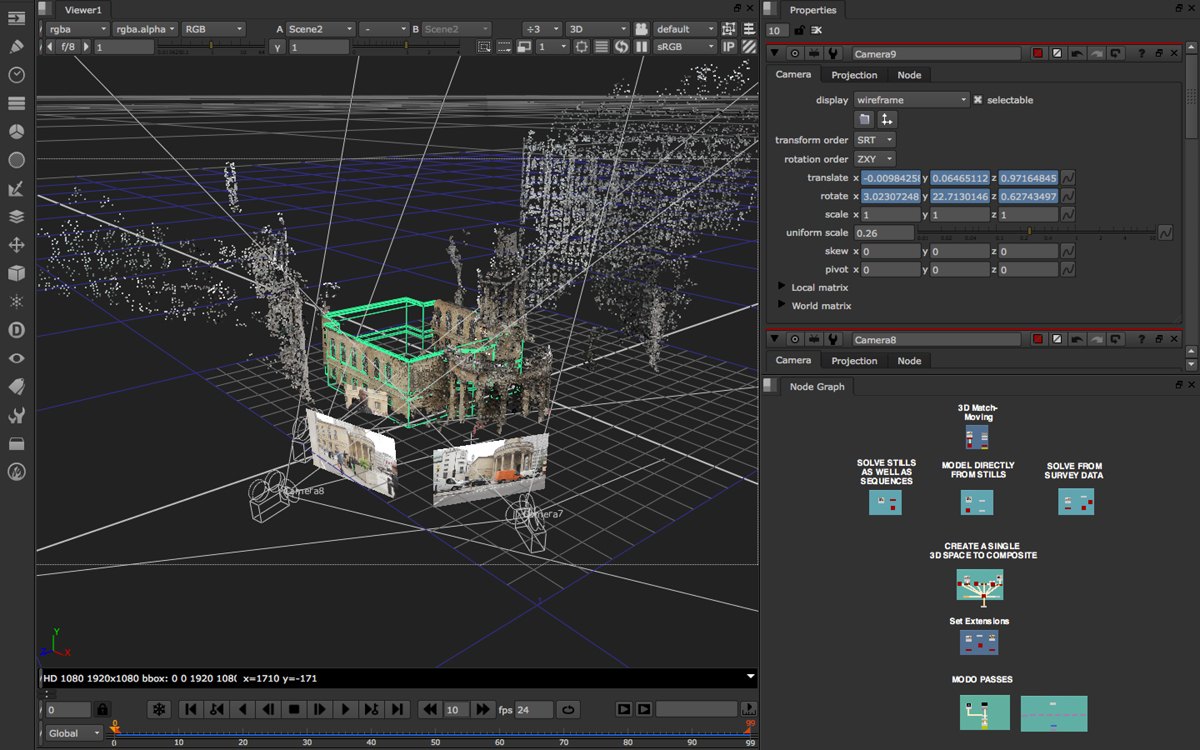
Camera Tracker – this is being updated to add to add to the set solve functionality and will let artists track and solve cameras from reference stills. The Model Builder will also feature UV creation.
Camera Tracker.
Camera Tracker.
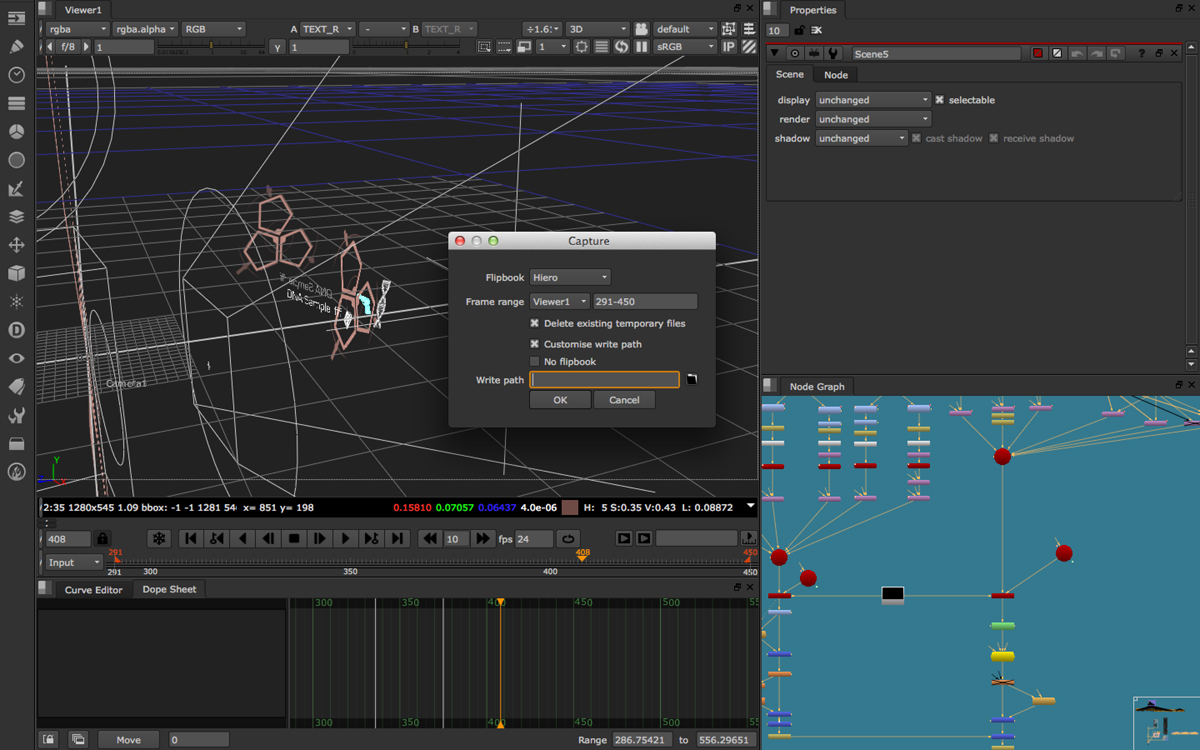
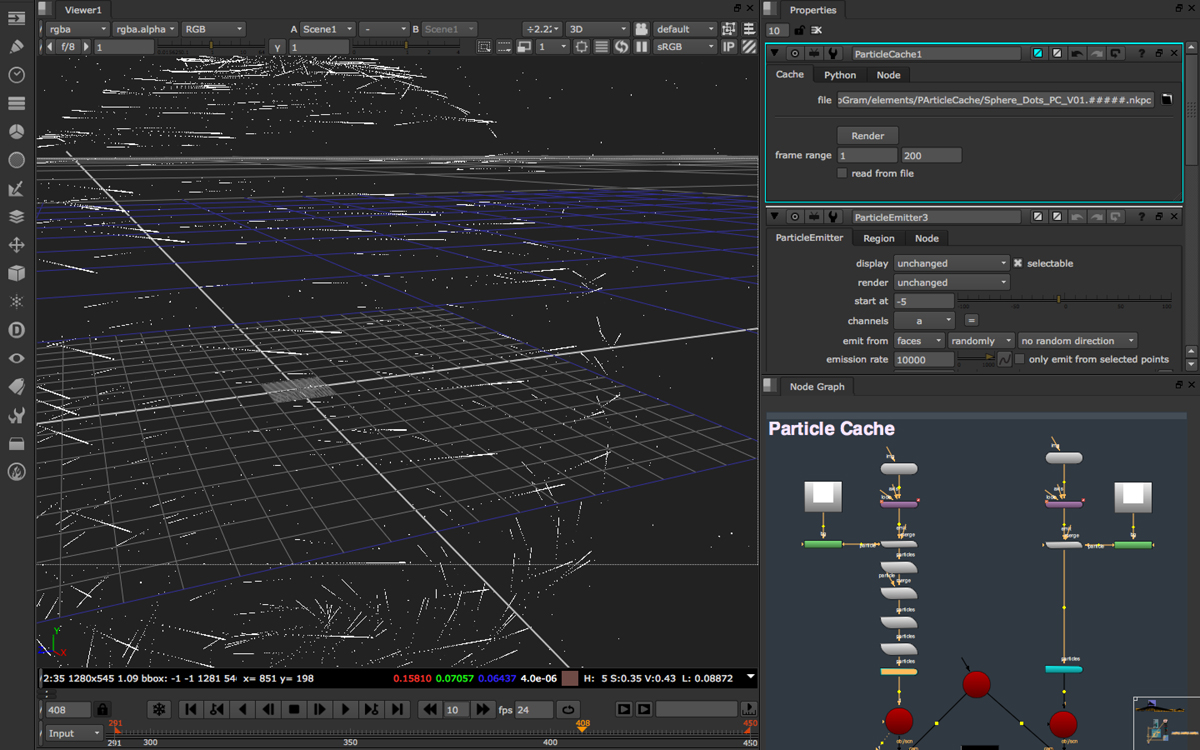
New 3D tools – includes Viewer Capture to allow users to flipbook images from the 2D and 3D Viewer, a new Edit Geo node, a Particle Cache node and the Wireframe Shader node for various visual effects and increased control over projection mapping.
Deep Output to the Scanline Renderer – part of the Deep Compositing workflow.
Open source – OpenEXR 2.0 multi-part image read and write support and Alembic 1.5 support.
In-context help system – this is a new feature for NUKE 8.
Developer tools – developers will be able to write their own image processing operations inside of NUKE using the new Blink Script node, which utilizes the GPU. Developers will also be able to rely on the new Import NUKE function to use NUKE as a module in any Python interpreter, and developers of C++ plugins will be able to output planar data via the new Planar Rendering Framework.
HIERO updates – changes include improved playback performance, color handling controls, and editing audio controls that will give users access to Per Track and Per Item Volume Controls.

NUKE Product Manager Jon Wadelton on NUKE 8

fxg: The Text node – how far will this go in allowing NUKE a greater role in solving graphic design style projects. Is this a stepping stone or do you believe you have a killer text node now?
Wadelton: We are really happy with the capabilities of the new Text tool. We believe it will make most graphic design projects much easier than before. We have common features such as typing in the viewer with cut/copy/paste, per character kerning, per character transform animation, group animation and more. It’s a huge step forward from the previous tool, but of course we never rest in the NUKE team so no doubt it’s still not the final iteration of the tool and it will evolve further in the future.
WireFrame Shader node.
WireFrame node.
fxg: The issue of colour grading has been a big deal for some time now with the Foundry not having a colour grading option. NUKE is aimed more at a shot than an entire edit…so how do you see this being used? Is this a path forward for HIERO – to adopt GPU colour grading?
Wadelton: We’re certainly making NUKE and HIERO work much more closely together. NUKE 8 for instance has adopted all the colour scopes tools from HIERO. We have been playing around with the idea of the reverse of this which we will be showing in our IBC The Foundry Labs demo this week.
As for the updated grading and colour correct tools in NUKE 8, we still see that as something you’d use to match individual elements or plates. We have a much more friendly colour wheel interface for all the colour tools, the new match grade tool, colour analysis scopes and options such as maintain luminance on the hue-correct and more.
fxg: How does the new Match Grade node compare to the old Furnace MatchGrade and/or the match grading algorithms of OCULA?
Wadelton: The new match grade allows you to analyse a sequence to give you a stable LUT that will grade one plate to match another. This differs to the old match grade that could only generate a grade from one frame. The new match grade also has options to export to the LUT to a file (e.g csp, cube etc). The algorithm has also been updated since the original furnace MatchGrade based on research used in OCULA.
ViewerCapture node.
ViewerCapture node.
fxg: The NUKE Camera tracker…any interest in accessing the i/tech (i/tech squared) data from Cooke and other lens companies being shown at IBC? PF Track will access the inertial guidance data and of course lens data/zoom etc
Wadelton: We have discussed accessing more camera metadata with Cooke and some camera manufacturers. This data could be used to lock off or restrict parameters to improve the camera solve. So it’s something we’re looking into for the future.
fxg: How much will the Particle Cache node speed up rendering? Have you benchmarked it?
Wadelton: The particle cache can considerably increase render speed and increase interactivity in a heavy script. The node caches out the particle simulation to disk. So once the artist is happy with the simulation it can be committed to disk eliminating the simulation time from overall render time.
Depending on how heavy the simulation is, this can save considerable time. It also really helps in the render farm situation where independent render slaves are each rendering a frame each. Without the cache these slaves would need to ‘run up’ the simulation to the frame that they are rendering, with the cache this is not necessary.
Above: NUKE Product Manager Jon Wadelton outlines the new features in NUKE 8.
fxg: Can you expand on what you can now do in the EditGeo node that you could not do before please?
Wadelton: The EditGeo node is a new node that allows you to move vertices and faces of geometry flowing down the node graph. It can save a round trip to a 3D application when your geometry is not quite right. For instance you are doing a projection and the geo and some verts are not quite in the right position. With the EditGeo you can quickly correct this in the comp.
TextNode.
TextNode.
fxg: Could you explain for people who don’t know what the Planar Rendering Framework is please?
Wadelton: It’s a new API for C++ developers who need to develop Planar or Tile based rendering plugins. NUKE is a scan-line based render system but not all algorithms fit to this style of rendering. Developers who need to render in tiles or planes can use the API rather than writing their own system to convert from scan-lines to tiles. The advantage for developers is much reduced complexity for implementing tiled rendering along with NUKE taking care of all the memory management. NUKE internally now uses this API for tile based rendering such as OFX, Blink based nodes and EXR files that are compressed into tiles. For the artist this will give them speed increases, reduced memory use, and more stability.
fxg: Could you discuss the adoption and success for Deep Comp pipelines that has lead to the scan-line Deep Output please?
Wadelton: Deep comp is becoming more widely used across film pipelines worldwide especially since more renders are starting to support the Deep EXR 2.0 format. A good example was MPC Vancouver’s work on Life of Pi for which they won them the VES outstanding compositing in a feature motion picture last year. That sort of shot would have been very difficult and time consuming without the deep compositing tools at the artist’s disposal. Part of the feedback we’ve had is that it would be great to integrate NUKE 3D elements into an existing deep scene, whether that be the NUKE particle system or just simple 3D elements to act as holdouts. That’s what we’ve added in NUKE 8. The NUKE internal scan-line render can now produce deep data directly to integrate with your existing deep elements.
ParticleCache.
ParticleCache.
fxg: How extensive has the beta process been? When can people download NUKE 8?
Wadelton: We have been in closed beta for several months and the feedback has been really positive. We will be opening this up very soon.
fxg: The Dope Sheet is a great advance – can you discuss the user feedback – from Beta or other – that shaped its development please?
Wadelton: NUKE has always had powerful procedural ways of moving and retiming elements around in time. The feedback we had was that you were very much shooting in the dark as to where all your elements had been moved to, so you could get lost fairly easily. The new dope-sheet solves this by showing all the keys and all the elements at their time shifted locations in a context sensitive way. So if you view keys before a node that moves them in time, you see them at their original time. If you view after the time manipulation, you also see them where they’ve been shifted too.
Courtesy : www.fxguide.com 

Wednesday, October 23, 2013

Manna Dey: Thank you for the music


Prabodh Chandra De, better known as Manna Dey, one of Bollywood's best-loved voices, died in Bangalore after a prolonged illness. The voice behind Laga chunri mein daag from Dil Hi To Hai, Ae Meri Zohra Jabeen from Waqt, Yeh Dosti from Sholay, Babu Samjho Ishaare from Chalti Ka Naam Gaadi and other memorable Bollywood hits, Manna De celebrated his 94th birthday this year and was awarded West Bengal's prestigious Vishesh Maha-Sangeet Sammaan in April. 
Manna Dey was born on May 1, 1919 in Kolkata. He began singing while still in school and stood first in various inter-college competitions while at Kolkata's Scottish Church College.Manna De took his first formal music lessons from his uncle Krishna Chandra Dey, who was a music director and composer, and began his Bollywood career as his uncle's assistant in 1942.
He worked independently as a music director for various Hindi movies before making his singing debut with the movie Tamanna in 1943. His very first mentors were Ustad Aman Ali Khan and Ustad Abdul Rahman Khan from whom he took lessons in Hindustani classical music.
One of the greatest playback singers in Indian cinema, Manna De sang in many Indian languages including Hindi, Bengali, Assamese, Gujarati, Malayalam, Punjabi, Kannada and Bhojpuri. He partnered with Mohammed Rafi, Kishore Kumar, Lata Mangeshkar and Asha Bhosle for several hit duets. He also formed successful pairings with actors Raj Kapoor and Rajesh Khanna, and composers Salil Chowdhury, Hemant Kumar and Laxmikant-Pyarelal. 
Manna De ruled the playback music scene from the 1950s to the 1970s. Some of his greatest hits are: Laga chunri mein daag (Ae Mere Pyaare Watan (Kabuliwala, 1961), Zindagi Kaisi Hai Paheli Haai (Anand, 1970), Poochho Na Kaise Maine Rain Bitaayi (Meri Surat Teri Aankhen, 1963), Chalat Musafir Moh Liya Re Pinjare Wali Muniya (Teesri Kasam, 1966), Kaun Aaya Mere Mann Ke Dwaare (Dekh Kabira Roya, 1957), Kasme Vaade Pyaar Wafa Sab (Upkar, 1967) and Dil Ka Haal Sune Dilwaala (Shree 420, 1955). He sang Mehmood's part in the duet Ek Chatur Naar (Padosan), Raj Kapoor's part in Pyar Hua Ikrar Hua (Shree 420) and Yeh Raat Bheegi Bheegi (Chori Chori), and Pran's famous song from Zanjeer, Yari Hai Imaan. 
Manna Dey continued to sing at concerts and in Bengali cinema long after he had retired from Bollywood. Manna De was honoured with the Padma Shri in 1971. In 2005, he received the Padma Bhushan, India's third-highest civilian honour. He was also presented with the prestigious Dadasaheb Phalke Award in 2007 and received the Filmfare Lifetime Achievement Award in 2011.


Source: BBC India

Saturday, October 12, 2013

"redchillies.vfx Team has delivered 1500 VFX shots in "Chennai Express"..


redchillies.vfx”team has delivered 1500 VFX shots for Rohit Shetty’s Chennai Express.This Shahrukh Khan starrer movie that grossed 410 crores and has become highest grosser in Indian Cinema

The team created many seamless complex CGI transitions complimenting the scenes and storyline of the film. So what was Rohit Shetty’s vision for the VFX of Chennai Express?  Keitan Yadav, COO of redchillies.vfx shares with Animation Xpress.com, “Rohit’s vision for the movie was to make the film look stunningly beautiful, rich & vibrant with breathtaking scenery, skies and colors.He wanted natural pleasant feel with very distinct feel to two villages. With magic hour environment at places and full open blue skies during journey the experience was enhanced. A lot of beautification has gone into songs like “Chipak Chipak ke” and “Titli”, informs Keitan

Haresh Hingorani (Harry), Chief Creative Officer, redchillies.vfx, adds here, “Rohit wanted us to instill mood transitions, instead of direct cuts or dissolves between shots. We then pre-visualized these sequences, and designed the transition to enhance the storyline, which has come out extremely good and being appreciated by the audience. 


The render time for certain VFX shots in the movie went up to 10-15 hours per frame as many shots were worked on 4K resolution and quite complex due to vegetation and waterbodies added.
Another sequence where tranquil beauty of a setup was enhanced is train coming to a stop at a waterfall. Landscape enhancement along with waterfall took this scene to a different level. This was shot during the dry season with mostly dry vegetation and very less waterfall due to off monsoon time.
Adding more Harry continues, “Here the waterfall was enhanced and 70% of greenery re-created in CGI, which took around 2 months to finish. One more shot was the 360 degree chopper shot in which around 80 percent of shot was created in CGI; the shot was stabilized, we added greenery and flowing streams to make the shot look spectacular.”

Also, the team created set extensions for vidamba village “We received a footage having 30 percent of houses and the rest had to be generated with CGI.” Highlights Harry
The prime challenge for the artists was to create heavy transitions seamlessly and realistically. It took around four months for the team to work on the different sequences of the movie.
Gradual transitions of journey progressing through the day made the train sequences more exciting, which were completely shot against green screen in a studio


Transition of a camera pulling out of the moving train through the window and rising high had multiple layers. This took lot of effort and artistic fineness to seamlessly integrate into one move combining live and CGI elements seamlessly.


Climax of the film had a hand to hand combat where props used were dangerous for actors, adding vfx helped keep the fight natural, it also has a burning stove being tossed around and finally concluding into a huge blast

Scenic shots like the train pulls in to a station in early morning; to transitions like the day turning into evening via mobile phone; to a transition where the train enters a tunnel in the evening and the headlight of the trains transforms into a beautiful full moon revealing the landscape at night where the train is passing over a bridge on the river are some more master shots created by redchillies.vfx using visual effects skills.” asserts Keitan. The redchillies.vfx team received interesting reviews on entire movie as people are grateful for showing India so beautiful and never before seen scenery.

Source: Animationxpress


Thursday, October 10, 2013

A Tribute to Srihari – The Multifaceted Actor!


Raghumundri Srihari, better known as Srihari by Telugu Film Industry was one of the most versatile, captivating and multi-faceted actors the film world had. Beginning his career as a stunt master, he evolved eventually to one of the highest paid character actors of Telugu Film Industry. His life speaks of hard work, dedication and tremendous talent throughout his career.
Srihari started off with negative roles in Tollywood, but later shifted to Comedy, Sentiment, Aggression and even Heroism. Nobody can forget the laughter he generated in films like Hello Brother, where he played a Singapore returned relative of the heroine (Soundarya) or Bavagaru Bagunnara, a funny proud villager who falls for the heroine (Rambha).  As a hero he was wonderful in roles showcasing sincerity, revenge, anger in films like Ayodhya Ramaiah, Simhachalam and Hanumanthu.
While continuing his tenure as Hero during post 2000s, he never failed to adorn memorable character roles such as the considerate brother in Nuvvostanante Nenoddantana, Dhee, King or even the recent Jr.NTR starrer Brindavanam. However, it was S.S.Rajamouli’s Magadheera which took his talent to new levels with Sher Khan/ Solomon character and people admired the amazing talent of Srihari. He recently made a Bollywood entry withToofan as a villain opposite Ram Charan.  Srihari was best known for his powerful dialogue delivery and ability to excel in any sort of emotion at ease.

Despite being a talented actor, Srihari was so human at heart that established Akshara Foundation in the fond memory of his lost daughter. He was a great philanthropist and adopted four villages near Medchal area for caretaking.
Srihari died of Liver Cancer in Lilavati Hospital, Mumbai today. His sudden demise today has been a shock to the entire Telugu Film industry and Film lovers. Telugu Film Industry not only lost a great actor, but also a wonderful human being with philanthropist values and ideals. Though he is physically not present in this World, his films and performances along with the good work he did off the screen will always be remembered. iQlik Movies offers deep condolences to his family and remembers the wonderfully talented character actor.