Thursday, February 20, 2014

Channel 4 goes out of this world with the VFX company behind 'Gravity' to promote Live from Space season


Channel 4 has partnered with Oscar and BAFTA award-winning VFX company Framestore, the company behind last year's blockbuster Gravity, to create the marketing campaign for next month’s Live from Space season.
The on-air campaign, directed and produced by 4Creative, invites viewers to ‘Go to space with Channel 4’ and will air from today (Wednesday 19 February) across the Channel 4 portfolio and during The Brit Awards 2014 on ITV this evening.
“We wanted to remind people how being an astronaut is the most dangerous, insane, rock 'n' roll job on the planet,” said heads of 4Creative, Chris Bovill and John Allison of the campaign.
Fronted by Dermot O’Leary Live from Space season includes three hi-spec shows from Arrow Media which deliver unprecedented access to NASA and gets up close and personal with real-life astronauts. Astronauts: Living in Space and Astronauts: Houston We Have a Problem will broadcast ahead of interactive TV event – Live from Space: Lap of the Planet – broadcast from the International Space Station (ISS) and Mission Control in Houston as the ISS completes an entire orbit of the Earth.

Courtesy : http://www.thedrum.com/

Thursday, February 13, 2014

British Animation Awards 2014 Finalists Announced


The biennial British Animation Awards have announced their slate of nominees for 2014. This year sees the introduction of two new categories: Best Voice Performance and Student Excellence; the latter stands in addition to the existing Best Student Film category, while the former led to the BBC website opening a news report with the brilliant sentence “Nighy was nominated for his voicing of a corpse in a short film.” The category for stop-motion commercials, meanwhile, has been dropped.

The awards, which are one-of-a-kind pieces of sheep-related artwork created by a who’s who of the animation communitiy, will be presented on March 7th at the BFI, Southbank. Here is the complete list of nominees:

Best Voice Performance
Morwenna Banks in Ben & Holly’s Little Kingdom: Nanny’s Magic Test
Bill Nighy in The Hungry Corpse
Tim Dann in Compost Corner

Best Long Form
Room on the Broom (Max Lang & Jan Lachauer)
The Pirates! In An Adventure with Scientists (Peter Lord)
The Snowman & The Snowdog (Hilary Audus)

Best Pre-School Series
Peppa Pig: “Mr Bull in a China Shop” (Philip Hall & Joris van Hulzen)
Q Pootle 5: “The Groobie Woogie” (Adam Shaw)
Sarah & Duck: “Bobsleigh” (Tim O’Sullivan)

Best Children’s Series
Shaun the Sheep: “The Stand Off” (Lee Wilton)
Compost Corner (Westley Wood)
Amazing World of Gumball: “The Apology” (Ben Bocquelet & Mic Graves)

Best Mixed Media Children’s
Baby Jake: “Popping Peas” (Maddy Darrall & Rafa Canales)
Num Tums: “No 5” (Steve Smith)
Get Squiggling Letters: “Letter A” (Dan Edgley & Adrian Hedley)

Best Music Video
Benjamin Scheuer: “The Lion” (Peter Baynton)
Atoms for Peace: “Before Your Very Eyes” (Andrew Thomas Huang)
Savages: “Marshal Dear” (Gergely Wootsch)

Best Commissioned Animation
NPSCC: Sarah’s Story (Moth Collective)
Apodemy (Katerina Athanasopoulou)
RSPB: Vote for Nature (Morgan Powell & Neil Kidney)

Best 2D Commercial
Barclays: “Life Skills” (Marc Reisbig)
WWF: “We Don’t Farm Like This” (againstallodds)
“Mindfull” (Shay Hamias & Will Barras)

Best 2D Commercial
TSB: “The Story” (Marc Craste)
Talk Talk: “Model Britain” (Daniel Kleinman)
Honda: “Hands” (Smith & Foulkes)

Best Film/TV Graphics
Filth Credits (Frater)
BBC Olympics: “Stadium UK” (Pete Candeland)
“Gumball Machine” (Damian Hook & Daniel Fuller)

Best Short Film
Marilyn Myller (Mikey Please)
Everything I Can See From Here (Sam Taylor & Bjorn-Erik Aschim)
In the Air Is Christopher Gray (Felix Massie)

Best Student Film
Anomalies (Ben Cady)
Shirley Temple (Daniela Sherer)
The Day I Killed my Best Friend (Antonio J Busto Algarin)

Student Excellence
The Laughing Policeman (Marcus Armitage)
Gutenberg (Amalie Vilmar)
I am Tom Moody (Ainslie Henderson)

Best Motion Graphics
Handle with Care (Jun Iwakawa)
Darkside (Darren Dubicki)
Apocalypse Rhyme (Oliver Harrison)


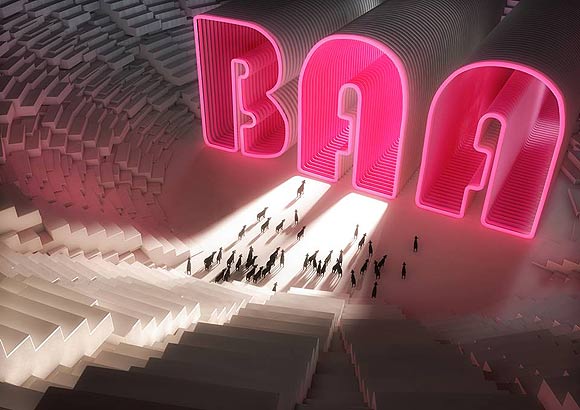
(BAA illustration by Katerina Athanasopoulou)

courtesy : www.cartoonbrew.com 

Balu Mahendra, who made his visuals speak, dies at 74


Balu Mahendra, a pioneer cinematographer feted for his use of natural lighting and film-maker who explored offbeat subjects using realistic portrayals, died at a hospital here on Thursday. Mahendra, who inspired and mentored a generation of directors, was 74. Doctors said he had renal problems and had suffered a heart attack.

Mahendra worked in all south Indian languages and created enduring works in each, as also in Hindi. His best known works include 'Moonram Pirai', 'Veedu' and 'Sandhya Raagam' (all in Tamil), 'Olangal', 'Oomakuyil' and 'Yathra' (Malayalam), 'Nireekshana' (Telugu) and 'Sadma' (Hindi).

Born Balanathan Mahendran to a Tamil family in Sri Lanka, he was drawn to cinema after watching the shooting of David Lean's 'The Bridge On The River Kwai' while on a school field trip. This inspired him to take a course at the Film and Television Institute of India, Pune, where he earned the gold medal in the cinematography course in 1969.

Mahendra entered the film industry as a cinematographer at a time when studios were in decline and mainstream entertainment was being reinvented. He came into the spotlight with 'Nellu' (1974) directed by legendary film-maker Ramu Kariat, who saw his diploma film at the institute and was impressed. 'Nellu' fetched him praise and best cinematographer award at the Kerala state film awards.

"He had a knack of letting his visuals speak several emotions. His visuals could create more impact than any lines in a film," said director K Vishwanath, who had used him as cinematographer for Sankarabharanam.

Mahendra went on to handle the camera for landmark films before graduating to direction. Although he remained within the popular format of film-making, he attempted to subvert genres with his study of character and psychology. His film-making career began with 'Kokila' (Kannada, 1977), which won him the National Award for best cinematography and the Karnataka state film award for best screenplay.

His next venture was 'Azhiyadha Kolangal' (Tamil, 1979), a coming of age story of three boys that the director has said was autobiographical. It did well at the box office and he moved on to 'Moodupani' (1980), a psychological thriller inspired by Alfred Hitchcock's 'Psycho', which was also a huge hit.

But the film that brought him the most acclaim was 'Moonram Piram' (1982), which ran for almost a year in theatres and won him the National Award for best cinematography and best actor award for Kamal Haasan. It also won a host of Tamil Nadu state film awards and Filmfare awards. He remade it as 'Sadma' in Hindi the next year; it did not prove to be successful but attained cult status much later.

Not surprisingly, filmmaker Madhur Bhandarkar posted on social media on Thursday: "Sad to hear the demise of master of innovative camera style, natural lighting, maker of my favourite Hindi film Sadma. Balu Mahendra, RIP." Mahendra went on to make landmark films such as 'Veedu' (1988), which won the National Award for best film in Tamil, 'Sandhya Raagam' (1989), which won the National Award for best film on family welfare, and 'Vanna Vanna Pookkal' (1992), which won the National Award for best feature film in Tamil. Other notable films were 'Marupadiyum' (1993), an adaptation of Mahesh Bhatt's Hindi film 'Arth', and the rip-roaring 'Sathi Leelavathi' (1995), in which he proved that comedy was also part of his repertoire.

His later films - 'Raman Abdullah' (1997), 'Julie Ganapathy' (2003) and 'Adhu Oru Kana Kaalam' (2005) — failed to make much of an impact, which prompted him to turn to teaching. He began the Balu Mahendra Cinema Pattarai in 2007, offering courses in cinematography, direction and acting and mentored filmmakers, such as Bala, Ameer, Sasikumar, Vetrimaaran and Seenu Ramasamy who have won multiple National Awards between them.

But with 'Thalaimuraigal' (2013), a tale of an old man's relationship with his grandson, he sort of redeemed himself, with the movie coming in for praise from critics and audiences alike.

One of his biggest regrets was that though Tamil Nadu had many chief ministers who hailed from the film industry, none of them had taken an initiative to preserve cinema. At many forums, he lamented the lack of a archive for Tamil cinema after the negatives of his film like 'Veedu', 'Sandhya Raagam', 'Marupadiyum' and 'Sathi Leelavathi' were destroyed. It's time one of Mahendra's illustrious students takes up the task of preserving his memory.

Wednesday, February 5, 2014

Baahubali all set to create a VFX splash


Loaded with VFX splendor, Rajamouli's film promises to be a visual extravaganza on an unprecedented scale. Director SS Rajamouli's Baahubali is set to create a new benchmark for visual effects in Indian cinema. The film promises to be a visual effects extravaganza with over 4,500 VFX shots. This is a new record in Indian cinema, surpassing the likes of Shah Rukh Khan's Ra.One and Hrithik Roshan's Krishh 3.

Set in an imaginary medieval realm, the film is loaded with computer generated imagery that promises to blur the lines between real and imaginary. Producer Shobu Yarlagadda reckons the movie will be a 'technical marvel'. "We want to offer the audience a real visual spectacle and have been working in that direction from the outset. It's a period drama that will transport the audience into a world of ancient forts, palaces, epic war sequences and the works. The VFX is going to be the most crucial element in the movie. We have the best national and international experts working on the film," says Shobu.

Srinivas Mohan is working as the VFX supervisor for the movie which has a slew of internationally renowned VFX artistes. Some of the visual effects are being done locally while some are being outsourced to foreign technicians around he world. Considering the scale and quality of the VFX work, the film is tipped to have the highest budget for VFX in Indian cinema.

Buzz is that the budget of the film is a staggering `100 crore. However, Shobu gets a little cagey when talking about the budget. "I cannot comment on that since I don't know about the budgets of other films. It is a very expensive film," he says.

Starring Prabhas, Rana, Anushka and Tamannaah in lead roles, the film is set for a 2015 release across all South Indian languages.


Friday, December 20, 2013

Monday, December 2, 2013

Shah Rukh Khan's Red Chillies VFX likely to work on Salman Khan’s 'Kick'

Srk
 
 
Ever since the release of Krrish 3, Shah Rukh Khan's Red Chillies VFX has been garnering a lot of appreciation for their visual effects in the super-hero flick. Thus, it won't be surprising, if the company is brought on board for several other films as well. Buzz is that Red Chillies VFX may work on Salman Khan's Kick, though there's no confirmation on this front as of now. This Salman Khan starrer film helmed by Sajid Nadiadwala has been in news for a while, it is currently in midst of a marathon shooting schedule in Panvel.
Now with there being a minute possibility of Salman Khan and Shah Rukh Khan working together in a film, at least Kick would be instrumental in getting them together offscreen at least. As of now though, Salman is shuffling between the shoot of Kick and Sohail Khan's Jai Ho. In the meanwhile, Red Chilies VFX, is working on Farah Khan's Happy New Year as well.

Friday, November 8, 2013

NUKE 8 is coming: here’s what you need to know

A new version of The Foundry’s flagship product will be shipping in 2013, with the company announcing at IBC that NUKE 8 is set for launch later this year. The Foundry’s timeline tool for NUKE, HIERO, will also be upgraded to version 1.8 this year.
fxguide speaks exclusively to NUKE Product Manager Jon Wadelton about the changes – see below. But first, just what are the main upgrades in NUKE 8?
Dope Sheet – artists will be able to see and move keys around in the context of a timeline style view. They will be able to see the results and each property of a node accurately displayed in context. The Foundry says the new viewing capability will make working with any scripts that involve time manipulation a much more simple process
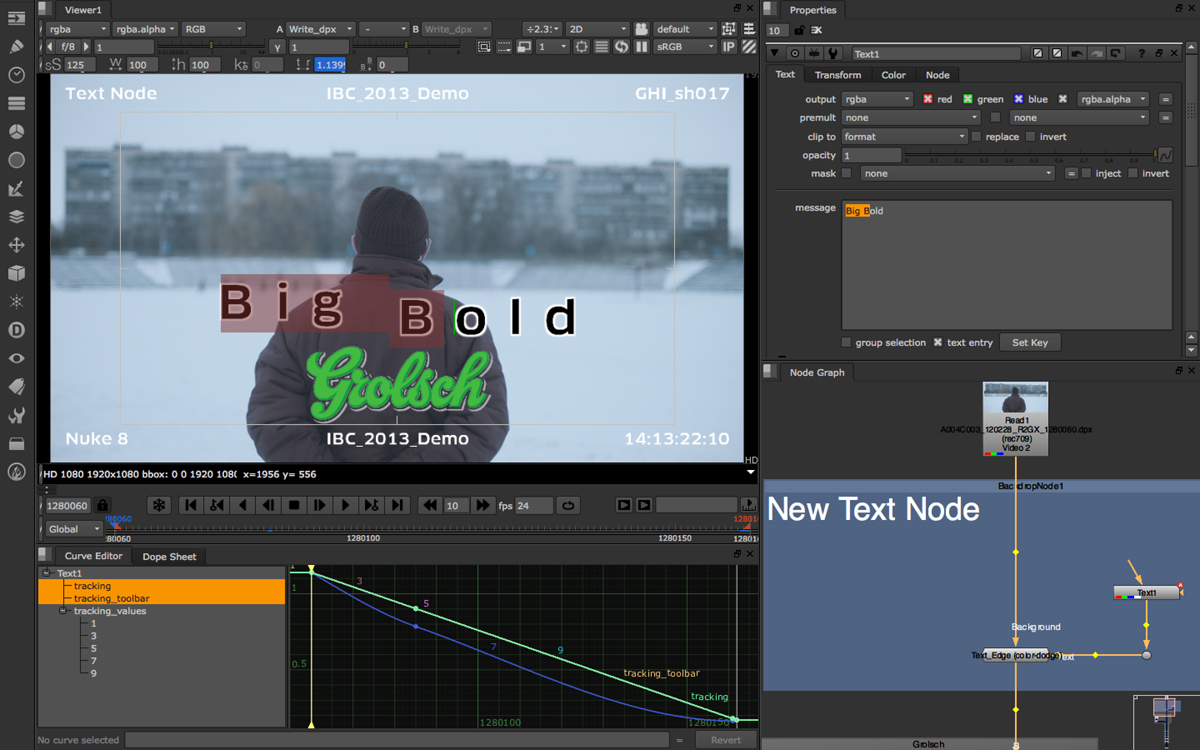
New Text node – lets artists compose, edit and animate directly in the viewer.
Color grading and correction – the NUKE UI has been updated to include an in-panel color wheel to control hue, saturation and value, with an automatic precision mode or optional absolute mode for finer tweaking. There’ll also be a new Pixel Analyser and a Match Grade node.
New scope tools – can be used to analyse the picture like Waveform, Vectorscope and Histogram viewers.
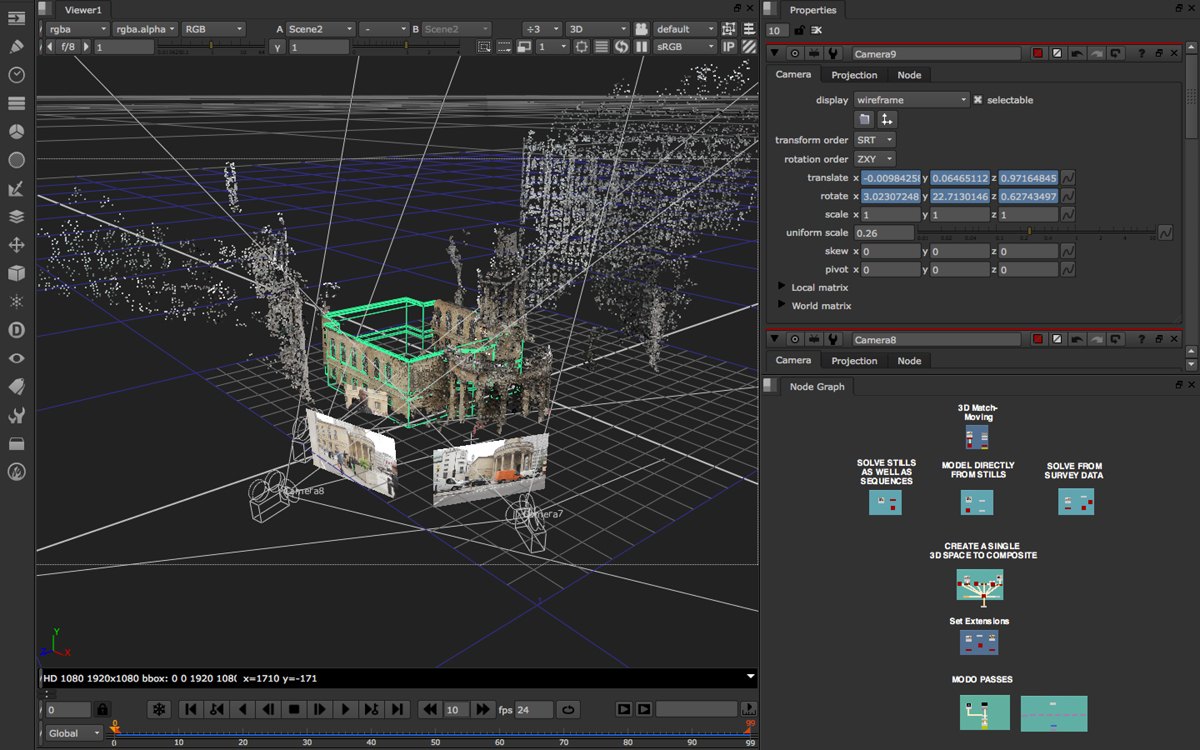
Camera Tracker – this is being updated to add to add to the set solve functionality and will let artists track and solve cameras from reference stills. The Model Builder will also feature UV creation.
Camera Tracker.
Camera Tracker.
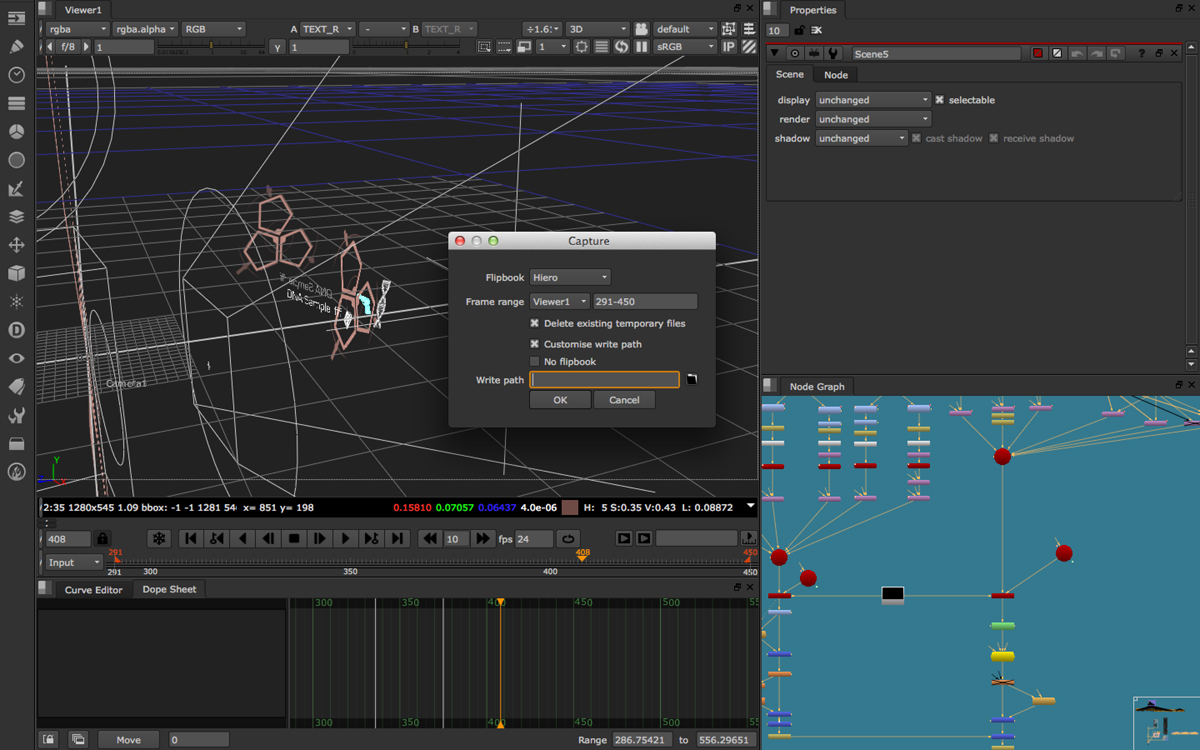
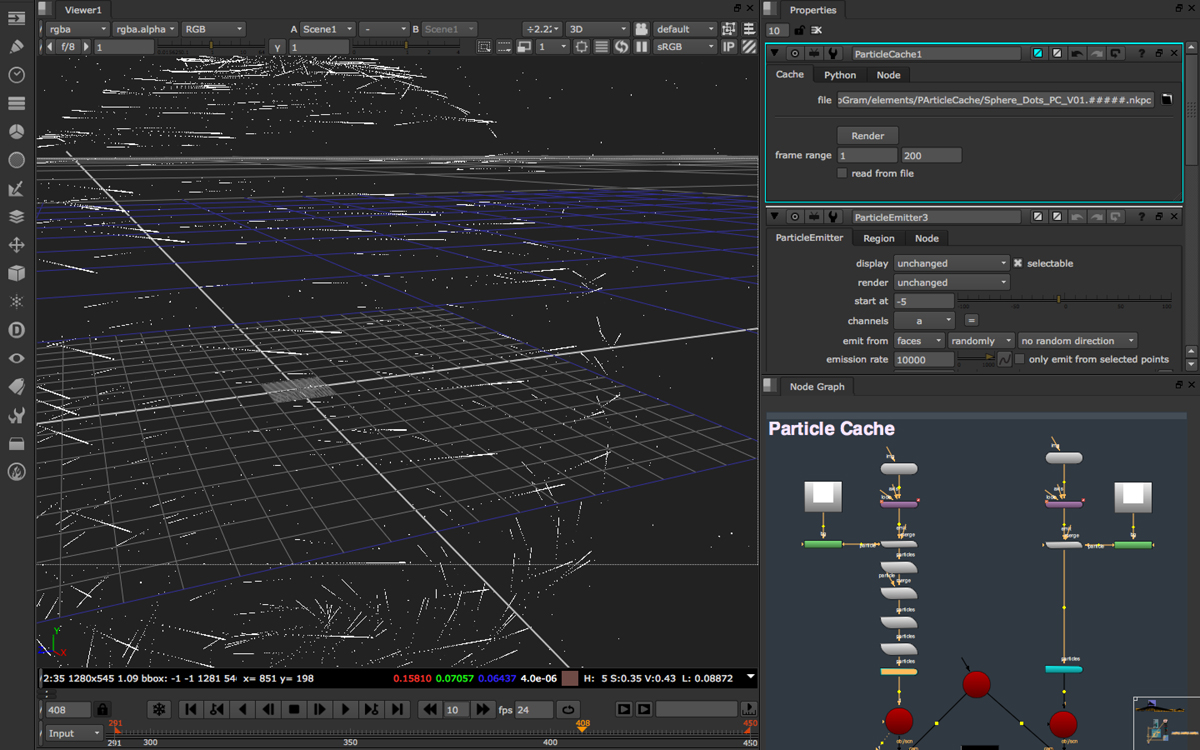
New 3D tools – includes Viewer Capture to allow users to flipbook images from the 2D and 3D Viewer, a new Edit Geo node, a Particle Cache node and the Wireframe Shader node for various visual effects and increased control over projection mapping.
Deep Output to the Scanline Renderer – part of the Deep Compositing workflow.
Open source – OpenEXR 2.0 multi-part image read and write support and Alembic 1.5 support.
In-context help system – this is a new feature for NUKE 8.
Developer tools – developers will be able to write their own image processing operations inside of NUKE using the new Blink Script node, which utilizes the GPU. Developers will also be able to rely on the new Import NUKE function to use NUKE as a module in any Python interpreter, and developers of C++ plugins will be able to output planar data via the new Planar Rendering Framework.
HIERO updates – changes include improved playback performance, color handling controls, and editing audio controls that will give users access to Per Track and Per Item Volume Controls.

NUKE Product Manager Jon Wadelton on NUKE 8

fxg: The Text node – how far will this go in allowing NUKE a greater role in solving graphic design style projects. Is this a stepping stone or do you believe you have a killer text node now?
Wadelton: We are really happy with the capabilities of the new Text tool. We believe it will make most graphic design projects much easier than before. We have common features such as typing in the viewer with cut/copy/paste, per character kerning, per character transform animation, group animation and more. It’s a huge step forward from the previous tool, but of course we never rest in the NUKE team so no doubt it’s still not the final iteration of the tool and it will evolve further in the future.
WireFrame Shader node.
WireFrame node.
fxg: The issue of colour grading has been a big deal for some time now with the Foundry not having a colour grading option. NUKE is aimed more at a shot than an entire edit…so how do you see this being used? Is this a path forward for HIERO – to adopt GPU colour grading?
Wadelton: We’re certainly making NUKE and HIERO work much more closely together. NUKE 8 for instance has adopted all the colour scopes tools from HIERO. We have been playing around with the idea of the reverse of this which we will be showing in our IBC The Foundry Labs demo this week.
As for the updated grading and colour correct tools in NUKE 8, we still see that as something you’d use to match individual elements or plates. We have a much more friendly colour wheel interface for all the colour tools, the new match grade tool, colour analysis scopes and options such as maintain luminance on the hue-correct and more.
fxg: How does the new Match Grade node compare to the old Furnace MatchGrade and/or the match grading algorithms of OCULA?
Wadelton: The new match grade allows you to analyse a sequence to give you a stable LUT that will grade one plate to match another. This differs to the old match grade that could only generate a grade from one frame. The new match grade also has options to export to the LUT to a file (e.g csp, cube etc). The algorithm has also been updated since the original furnace MatchGrade based on research used in OCULA.
ViewerCapture node.
ViewerCapture node.
fxg: The NUKE Camera tracker…any interest in accessing the i/tech (i/tech squared) data from Cooke and other lens companies being shown at IBC? PF Track will access the inertial guidance data and of course lens data/zoom etc
Wadelton: We have discussed accessing more camera metadata with Cooke and some camera manufacturers. This data could be used to lock off or restrict parameters to improve the camera solve. So it’s something we’re looking into for the future.
fxg: How much will the Particle Cache node speed up rendering? Have you benchmarked it?
Wadelton: The particle cache can considerably increase render speed and increase interactivity in a heavy script. The node caches out the particle simulation to disk. So once the artist is happy with the simulation it can be committed to disk eliminating the simulation time from overall render time.
Depending on how heavy the simulation is, this can save considerable time. It also really helps in the render farm situation where independent render slaves are each rendering a frame each. Without the cache these slaves would need to ‘run up’ the simulation to the frame that they are rendering, with the cache this is not necessary.
Above: NUKE Product Manager Jon Wadelton outlines the new features in NUKE 8.
fxg: Can you expand on what you can now do in the EditGeo node that you could not do before please?
Wadelton: The EditGeo node is a new node that allows you to move vertices and faces of geometry flowing down the node graph. It can save a round trip to a 3D application when your geometry is not quite right. For instance you are doing a projection and the geo and some verts are not quite in the right position. With the EditGeo you can quickly correct this in the comp.
TextNode.
TextNode.
fxg: Could you explain for people who don’t know what the Planar Rendering Framework is please?
Wadelton: It’s a new API for C++ developers who need to develop Planar or Tile based rendering plugins. NUKE is a scan-line based render system but not all algorithms fit to this style of rendering. Developers who need to render in tiles or planes can use the API rather than writing their own system to convert from scan-lines to tiles. The advantage for developers is much reduced complexity for implementing tiled rendering along with NUKE taking care of all the memory management. NUKE internally now uses this API for tile based rendering such as OFX, Blink based nodes and EXR files that are compressed into tiles. For the artist this will give them speed increases, reduced memory use, and more stability.
fxg: Could you discuss the adoption and success for Deep Comp pipelines that has lead to the scan-line Deep Output please?
Wadelton: Deep comp is becoming more widely used across film pipelines worldwide especially since more renders are starting to support the Deep EXR 2.0 format. A good example was MPC Vancouver’s work on Life of Pi for which they won them the VES outstanding compositing in a feature motion picture last year. That sort of shot would have been very difficult and time consuming without the deep compositing tools at the artist’s disposal. Part of the feedback we’ve had is that it would be great to integrate NUKE 3D elements into an existing deep scene, whether that be the NUKE particle system or just simple 3D elements to act as holdouts. That’s what we’ve added in NUKE 8. The NUKE internal scan-line render can now produce deep data directly to integrate with your existing deep elements.
ParticleCache.
ParticleCache.
fxg: How extensive has the beta process been? When can people download NUKE 8?
Wadelton: We have been in closed beta for several months and the feedback has been really positive. We will be opening this up very soon.
fxg: The Dope Sheet is a great advance – can you discuss the user feedback – from Beta or other – that shaped its development please?
Wadelton: NUKE has always had powerful procedural ways of moving and retiming elements around in time. The feedback we had was that you were very much shooting in the dark as to where all your elements had been moved to, so you could get lost fairly easily. The new dope-sheet solves this by showing all the keys and all the elements at their time shifted locations in a context sensitive way. So if you view keys before a node that moves them in time, you see them at their original time. If you view after the time manipulation, you also see them where they’ve been shifted too.
Courtesy : www.fxguide.com