Saturday, April 20, 2013

99 years later, Raja Harishchandra (1913) goes 3D

In India, cinema isn't just a passion. It is frenzical. We have perhaps inherited this acute addiction from the man who started it all, 99 years ago - the Father of Indian Cinema Dhundiraj Govind Phalke (1870-1944). Dadasaheb Phalke as we better know him as, held the first show of Raja Harishchandra what is widely considered to be the first Indian feature film at Bombay's Olympia Picture Palace on April 21, 1913. The commercial screenings started 12 days later, on May 3, 1913 at Coronation and Variety Hall, Sandhurst Road, Girgaum, Bombay.

Most of us have seen only fleeting glimpses of this bud, that gradually grew to the mammoth movie industry that we have in India today. That Raja Harishchandra (the actual film title spells it as Raja Harischandra, minus the 'h' following the 's') should be one of the first films on the India Public Domain Movie Project collection was a foregone conclusion.
Since Phalke made the best of the technology available to him at his time, I thought it would be a tribute to the innovator in him to convert the film in 3D 99 years after its release. Using YouTube's 3D conversion technology you can also watch Raja Harishchandra in 3D. In the video embedded below, click on the settings (gear) icon and the 3D link will appear from there choose greyscale and also the type of 3D glasses you own to watch how India's first feature looks in a 3D avatar (Don't expect a Avatar though).
Here are 11 minutes and 19 seconds of what is left of the landmark film (India's film archival history is not something that we can be very proud of).
What you see above is only the first reel of the film and I will try to get access to the remainder. This video has been extracted and edited from a 1967 documentary DG Phalke, The First Indian Film Director 1870-1944 produced by the Indian National Film Archive.
There is some confusion whether this film, preserved in the National Film Archives of India, is the actual 1913 film or a 1917 remake of the film.
"Raja Harishchandra. A performance with 57,000 photographs. A picture two miles long. All for only three annas."
This is how Phalke, Indian cinema's first marketing wizard promoted his creation. Phalke had to make his soundless cinema with higher ticket prices appeal to an audience who were hooked to stage plays, then the reigning form of entertainment.
Raja Harishchandra wasn't the first Indian film, it was the first indigenously produced feature length film and Phalke's story of making the film is as interesting as a movie plot. Harishchandrachi Factory, the 2009 Marathi film on Dadasaheb Phalke that centres on the making of the movie is a must watch. Had the film not been a biopic, it could have also passed as a well-made subtle comedy. This UTV produced Paresh Mokashi directed movie was also India's official nomination to the Oscars for Best Foreign Language Film. My suggestion is that you view Raja Harishchandra before you sit down to watchHarishchandrachi Factory. When you see the same scenes recreated almost a century later on a film canvas that's much wider, the impact is that much greater.
Phalke is often compared to the French film pioneer Georges Melies, both considered the medium as an art form and also had expertise in magic tricks and that knowledge they made use of for special effects in their films.
"Raja Harishchandra. A powerfully instructive subject from the Indian mythology. First film of Indian manufacture. Specially prepared at enormous cost. Original scenes from the sacred city of Benaras. Sure to appeal all Hindu patrons," read a pamphlet promoting the film).
The entire show, apart from the movie included other forms of non-film entertainment as well. Raja Harishchandra was also exhibited in London in 1914.
The story for the movie was from the great epic Mahabharata and espouses the belief that truth always triumphs. Harishchandra was a legendary pious king of Ayodhya who sacrificed his kingdom, wife and child for the sake of truth.Harishchandrachi Factory tells us that this story was a favourite with Phalke's sons and his eldest son Bhalachandra Phalke also played Rohitashwa, Harishchandra's son in the movie. Another important reason why this story was chosen for the film was that Harishchandra was a popular theme in the Marathi and Urdu theatre of the day. The story again found itself in another first-of-its-kind movie, the first Marathi talkie, V Shantaram's Ayodhyecha Raja (1932), which was also released in Hindi, making it the first Indian film to be released in two languages.
Raja Harishchandra was shot in a bunglow (apart from other outdoor locations) called Mathura Bhawan (owned by one Mathuradas Makanji) located on a street in Dadar, Bombay that is now rightly named Dada Saheb Phalke Road.
The acting was in traditional Indian folk theatre style, the influence of which and Parsi Theatre were to remain on Indian acting for decades. In the absence of sound (that was to make an appearance in Indian cinema 18 years later with Alam Ara), there were title inserts between shots explaining the plot. In Raja Harishchandra (and most of the films of the silent era) these title plates were in two languages - English, the language of the elite and Hindi (or other Indian language) - the language that the masses understood.
The Phalkes were also perhaps the first Indian film family. His entire family, including him, his wife Saraswati Phalke, eight children (five sons and three daughters) were all involved in the filmmaking process, with Saraswati handling some of the technical process including developing the film. His daughter, Mandakini Phalke, was in fact one of the first female actresses on the Indian screen at a time when acting in films was a much derided profession.
Dhundiraj Govind Phalke was to follow the initial success of Raja Harishchandra with other landmark films such as Lanka Dahan (1917). A prolific filmmaker, Phalke went on to make over a hundred films but died in poverty.
Of the original 3700 feet of the original film (that took 6 months and 27 days to put together) only some fragments could be preserved by the National Film Archive of India, Pune which includes portions of the first and the last reel of the film.
If a mere thousand words aren't sufficient to quench your thirst for Phalke info, head to phalkefactory.net is a (albeit unorganised) treasure trove of information on the Father of Indian Cinema.
Courtesy: soumyadip Choudhurys Blog IBN Live 

Friday, April 19, 2013

Media industry in India seen growing 12 percent in 2013: KPMG


(Reuters) - The media and entertainment industry in India is expected to grow 11.8 percent in 2013, driven by digitisation and growth in new media, consultancy KPMG said in a report.

The industry is expected to touch 917 billion rupees this year, up from 820 billion rupees in 2012 when it grew by 12.6 percent, KPMG said in a release on Thursday.

Digitisation, general elections due next year and accelerating growth in new media are factors propelling the industry forward, it said.

In spite of Bollywood being the world's largest film industry, television dominated the media and entertainment landscape in India, growing 12.5 percent in 2012 and accounting for 370 million rupees of total revenue.

Films were ranked third behind the print industry in terms of revenue, accounting for 112 billion rupees but up by 21 percent last year.

Digital advertising showed impressive growth of nearly 41 percent, with earnings surging from 15.5 billion rupees in 2011 to 21.7 billion rupees last year.

"The rapid increase in mobile and wireless connections continues to drive the growth of internet penetration in India," the release said.

"With better access, through cheaper and smarter devices, audiences (especially the youth) are consuming more content and are getting increasingly engaged," it said.

Advertising spends across media grew only 9 percent to 327.4 billion rupees last year, with the sector affected by the economic slowdown. It had grown by 12 percent in 2011 and 17 percent the previous year.


(Reporting by Shilpa Jamkhandikar; Editing by Tony Tharakan)
Courtesy : Reuters 

Reelhouse Paves the Way for the Future of Self-Distribution


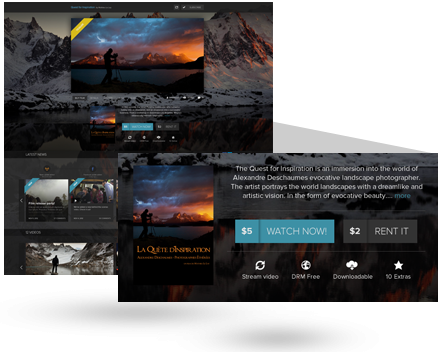
Each new day that passes it seems the world of distribution for filmmakers is being turned on its head. With so many new content destinations popping up all the time, it’s hard to know what’s what. Reelhouse is a company who seems to be breaking through the mold, as a recent partnership with Sundance would suggest. Reelhouse is planning a big launch on April 22nd — read on for our interview with Bill Mainguy, CEO and Founder of Reelhouse and get to know the platform:
Okay, first thing’s first — what is Reelhouse?
Reelhouse is an open video sharing community that offers film and video creators a rich toolset to self-distribute their content directly to their viewers via any internet connected device. Creators can choose between a series of monetization models while also leveraging customisation, marketing, merchandising and media features that provide an engaging experience for their audience; all within a community specifically for quality entertainment content
NFS: How did you guys start? Were you frustrated filmmakers who needed an outlet?
BM: Our designers and coders come from industries of gaming and film. We’re all viewers, and on one hand being kinda frustrated hearing from peers about places to distribute their work but also from the view of the masses, we want to improve the overall experience. The transition isn’t going to happen overnight, but we’re providing an alternative: the self-distribution model.
We’ve seen great stories that haven’t really had a chance to build their fanbase or reap any rewards from their viewers, so we want to help them out. And as we progressed, we found there’s potential for what they are missing out on and what the studios are missing out on: What are you getting other than just clicking “play?”
NFS: What motivated you to get into the self-distribution game?
BM: Our home and heart started with the independent community and giving them a means, it just so happens that it’s starting to apply to everyone else. Seeing more studio-based content on Kickstarter, like the Veronica Mars project, for example, is a sign of how people are adopting what was founded as an independent solution to the mainstream. The timing is just right.
It’s kind of a cliché, but in the new “direct to consumer paradigm,” something that Sundance noticed is that we’re good at getting films up and running on Reelhouse very quickly. Sundance is a great partner for us because they’re really open to latest and greatest ways of doing things to try to support their filmmaker community. We are also talking to a major studio in LA to see how it might match up with some of their properties, so we’re looking for ways that we can incorporate the players that have been in the game for a long time and show them and lead them into this world and incorporate both types on our platform.
NFS: I noticed that there looks be your own form of crowdfunding within Reelhouse. Can you talk about this?
BM: We’re not a site to come to if you have a concept that you want to make and you’re trying to get funding for it. Kickstarter is a great platform for that and we don’t want to compete with that. This is one of our more experimental or “far-out” features. Our whole crowdfunding function that you see on our site is for viewers that were inspired by the story could then, right when they’re in that moment of the story, could support it.
Self-distribution is all about connecting the content creator directly with the viewers, and once you start to do that, really cool things start to happen. Documentaries, for example, with a real-word component, if there’s a cause to contribute to. It’s more about different ways that the community can rally around a film post-watching.
For example, we had a series that was on-site journalism covering a pipeline that was being built in Northern Canada by Enbridge, and people were funding them directly on Reelhouse so they could stay up there. So they were funding their own news source in a way. We want people to get creative to harness the platform.
NFS: What about for narrative filmmakers?
BM: It’s really about giving the filmmaker the tools. The only thing we filter out are the Kickstarter-type funding videos, that’s not what our site’s about, but if a guy puts up a narrative film and says “Hey, if you like this piece and want to support me as a filmmaker, here are different rewards in exchange for supporting me.” There are very creative ways that filmmakers are leveraging these types of functions.
NFS: What does all this say about the future of the Theater experience?
BM: It’s an interesting question, and something that we’re not 100% connected to, but I’ll give a good plug for another platform called Tugg, which is a great platform that allows viewers to organize screenings in their communities if they can rally enough people. As a passionate person in this space, I feel there’s always that desire to have a community rally around the film watching experience, whether it’s in the theater or at home.
NFS: Do you think that your platform will help combat piracy? Is that a goal of yours?
BM: Piracy is definitely an issue, what we learned from our gaming background is: you’re not gonna be able to stop people from pirating. The reality is, if it’s viewable, it’s piratable. It’s like a new law of physics or something. We want to create an experience that can’t be replicated by torrenting, and it also has to be easier and accessible from anywhere, and enjoyable.
What we’re doing is allowing people to build value for what viewers are paying for. And I only think it will increase more and more when we offer things like being able to create your own app experience on the site, and opening up channels of interactivity on the site, I think that’s the key way to combat piracy.
Even Hollywood itself has enough trouble getting people to convert and pay for the content. If you know you’re paying the creator directly it helps. Our whole concept is offering up an entire experience when you land on a page, much more than just the video and trailer. You get the behind the scenes, the photos, there could be a virtual store where there’s physical and digital downloads. In the future we will have an embeddable app-layer.
Getting paid to watch content isn’t new, it’s more about a whole experience.
NFS: I like that when you go to a film’s page, it’s its own whole website. It’s very customizable, it’s all about the world of the film. It’s much more immersive.
BM: I like that you said that because that’s exactly what we say internally, we want to ensure that a filmmaker’s page will always be theirs. Whereas sites like YouTube are designed to distract you from what you’re watching — they’ll have other ads appear on your page, other people’s content that distract you away. There’s no way to create your own immersive world.
We really hold to the fact that your page is yours. We’ll never allow intrusive elements onto your page that you don’t have a say in. So in a way, it’s like you creating your own micro-site.
NFS: So there are no Ads at all?
BM: For now there are no ads. In the future we may look at some ways to have brand sponsorship and add revenue potentially, but we haven’t dived into that yet — we’re focussing on our first two business models: The first being that we take a 6% transaction fee, and we feel that’s fair for providing the platform. So if you sell merchandise, digital downloads, etc., we take a 6% cut. And then what we’re rolling out soon are the Pro Accounts, you’ll get metrics reporting and analytics on your page, more customization options, more memory. Also coming is an Enterprise account where various collectives and brands can stage their brand in a way that’s more robust for people who have a lot of content.
NFS: For the tech-heads, what’s under the hood of your web-player?
BM: We offer two different players so it’s viewable everywhere: a Flash player, and a default HTML5 player, encoding in H.264. HD throttles from 720 to 1080. We want to be on the cutting edge in the overall experience and strive to have the best encoding. We have plans to accommodate 4K as well. We’ve already had a couple time-lapses that offer the original 4K download in their virtual store.
Our embeddable player, when you share a project it will have breadcrumbs to your project. More than half of the traffic that projects get are from being embedded on different blogs. Whereas on YouTube or Vimeo there’s no real need for viewers to ever visit the page that the video originated from — just because there’s nothing there — but on Reelhouse there is tons more, the embeddable player will have elements of your store visible, or more videos, or about the artist. Also on comments, when viewers ask the same question over and over, so we made the ability for the creator to post a FAQ to answer these questions as to not muddy up the comments.
I don’t want to commit to this being a feature, but one of our investors Gener8 does 2D to 3D conversions for theatrical releases in Hollywood, so we get a lot of 3D expertise around us and we’ve talked about being one of the first 3D viewable platforms as well.
NFS: How do you curate the content? Can anyone upload, is there a submission process, how does it work?
BM: At the moment, we’re approving batches of content at a time as people sign up. That’s another way we’re different, we don’t only take feature films. We take web series, shorts, clips that are 3-5 minutes long — as long as it has some quality story element in it. We believe viewers have a wide appetite for what they want to watch. Since we’re in our Beta phase, we’re approving content because we just don’t want to get overwhelmed early on and want to maintain quality of content on our site. This community is solely for stories that are intended for mass distribution to an audience. This isn’t just a tool for filmmakers to use, we want them to associate themselves with it and have an affinity for what Reelhouse is beyond being just a website.
We have the ability to rent or sell your content, for us that’s not the be-all-end-all. That’s not the key, it’s about packaging more in the experience and offering new experiences as we progress.
NFS: Is there an aesthetic through-line with your platform? What about films with very explicit content?
BM: Our long-term goal for the platform is to provide an alternative where people can take control of their own distribution and be very democratic vs. the high gates of Hollywood. What we don’t like about that is a handful of people in the industry deciding whether something is a worthy story or not for distribution. So we don’t then want to go around and become those people and say ‘our team didn’t like it’ so therefore we’re not going to play it on our site. That’s the complete opposite of what we’re about. There’s tons of content that we’ve seen that didn’t really have a nice aesthetic, or didn’t really entertain us, but have become hugely successful.
NFS: Are you supporting international content? Subtitles?
BM: Yes, eventually. We’re toying with the idea of partnering with various crowd-sourcing subtitle solutions to allow the many people who have already offered a means to translate the films they love.
NFS: If I put my content on Reelhouse, is it exclusive? What are the benefits of being exclusive, if any?
At the moment it’s completely up to the creator whether they want to make it exclusive or not. We have yet to roll out benefits for making it exclusive here, but we believe there are implicit benefits for having your content in one place.
People have this notion that if you put it on more platforms it will get more coverage. If it’s online, it already has as much potential as you could want. It’s not like Vimeo will reach more people than YouTube can. We like to focus on giving users one consistent experience. You can always put a teaser on YouTube that will direct people to Reelhouse.
We will constantly be rolling out tools that help filmmakers market their stories to their audience. Whether it be an incentive to share the page to unlock store items or to set up a coming soon page to drum up hype and take pre-orders (coming shortly), it’s an important element of our platform. As we continue to grow as a platform, we expect that due to Reelhouse being a place only for stories and quality, that there will be more of an attentive eye on the content debuting here. Eventually, much like how Kickstarter transitioned, we will become a very active destination site.
NFS: What’s happening on the 22nd?
Our launch on the 22nd will be a significant update, the site will look different with tons of additional features. We’re still in Beta, but Beta doesn’t mean it’s this weird micro-version of what we’re going to be. It’s just a disclaimer that we’re iterating constantly.
…
It’s an exciting time for filmmakers, the technology finding its way into our hands, and now the power to self-distribute. A special thanks to Bill Mainguy at Reelhouse for his valuable inputs.


Courtesy : nofilimschool

Thursday, April 18, 2013

Music industry booms in digital makeover


New Delhi, March 17 -- If you still think music is all about purchasing CDs and cassettes, think again. A whole new world is helping the music industry stand up and boom after being hit by piracy and uncertainties.
Digital music in various forms and formats is filling up the coffers of old music firms. Independent artistes, internet services and new-age publishers are giving the industry a new lease of life. Ringtones, ringback tones, downloads and mobile radio streaming services, besides downloaded singles and albums from online stores are generating additional fees from mobile subscribers and more licensing revenue for record companies.

Subscription services from Apple and Google, expected soon, are likely to further fuel revenues of the music industry.

Forget the minor fact that record stores - like the Saregama-run Music World chain - are shutting down.
According to the latest International Federation of the Phonographic Industry (IFPI) digital music report, the Indian recorded music market grew for the third consecutive year in 2012, with digital sales overtaking physical sales.

"With 2012 revenue approaching an all-time high, some within the business believe India could be among the top 10 markets, globally," the report added.

It was, however, a different story a decade ago.
In the 2001-2003 period, the legal music market shrunk by 27% in unit terms and 38% in value terms, according to the Indian Music Industry, a body that represents over 140 music labels in India.

"During 2001, half of the 20 major music labels in Bollywood stopped. The year came as a shock to the music industry," said Shridhar Subramaniam, president, Sony Music, India and West Asia. "But good times are here again as the industry is poised to grow 25-30% year-on-year."

What initially saved the domestic music industry was mobile value-added services or VAS. Besides consumers services such as ringtones and downloads, the royalty paid to labels by mobile operators for using their songs, also helped in increasing sales.

Then came the growth of digital albums. By the end of last year, several countries including India, US, Norway and Sweden, saw digital sales making up more than half of the music revenue kitty, the digital report said.

"First we all thought digital was killing music but it has saved music," said Subramaniam.
"The real task for us is how to grow the music business and set a real goal of a billion dollars in annual revenues that we can achieve in the next decade," said Neeraj Kalyan, president, T-Series, which was once famous for cheap pre-recorded cassettes.

With over 500 labels releasing music in over 20 languages, India does offer a vast potential.
"We have been working hard to licence a range of services that meet the needs of consumers," said Devraj Sanyal, managing director, Universal Music India.

"India's music tastes are changing and with consumers open to modern interpretations of old Bollywood numbers, many labels have started investing in this area," said Subramaniam.

Published by HT Syndication with permission from Hindustan Times.

Tuesday, April 9, 2013

'Aatma' captivates with VFX power


After making thrillers like 'Ek Khiladi Ek Haseena' and 'Acid Factory', writer-director Suparn Verma has moved on to the horror genre with 'Aatma'. One thing that he was sure of before stepping into this new world, he had to ensure a world class treatment. 

This also meant that he was quite particular about keeping the transition from reality to special effects as seamless as possible so that audiences were entirely immersed in the narrative instead of being put off by a jerky narrative that at times becomes noticeable.

'Aatma' is a seamless integration of breath taking VFX, as well as amazing Colour Grading that blends the story to the experience creation. Suparn and Wide Frame Pictures worked with Reliance MediaWorks (RMW) to provide unprecedented 340 VFX shots for the film. DOP Sophie brings this out with support of Naveen and Santosh of Reliance MediaWorks.

Speaking on the same the director said, "In terms of VFX, we have taken it to the next level. Ours is a very small budget film and still we haven't compromised on quality and that too in a controlled budget." There are as many as 340 VFX shots in the film but they are not in your face; they are so well integrated in the film!' added Verma.  Suparn closely supervised the entire process as it was being undertaken at Reliance MediaWorks.

The film revolves around Maya (Bipasha Basu) who is  trying to save her daughter from the spirit of her ruthless, abusing and menacing husband Abhay (Nawazuddin Siddiqui), who for his unconditional, almost-bordering-on-obsession, love for his daughter comes back from the dead to take her with him. 'Aatma' released on big screens on 22nd macrh 2013.

"Today's editors and storytellers need the power of visual treatments, to create breakthrough content and build relationships with their audiences. 

The beauty of VFX here is that you don't know where it ends and where reality begins," says Naveen Paul (Creative Head for VFX). He credits the team comprising Sanjiv Naik, Abrez Mohammed, Vinoth Ganesh along with others who relentlessly worked on this right from creation to execution to deliver the best of both worlds.

An inspired, impactful way of directors to express themselves which resonates with their viewers comes through high end colour grading, which today forms an important component in mood creation of the film, adds Santosh Pawar, DI-Colourist, RMW.

Thursday, April 4, 2013

ProCutX, an iPad Control App for Final Cut Pro X, is Now Free for a Limited Time

We’ve seen a few apps capable of controlling different programs on your computer with an iPad. A recent app that caught our eye, ProCutX, is capable of controlling Final Cut Pro X with your iPad, and replacing many of the functions normally done with a keyboard. For a limited time (possible only a few more hours), the full app, which is normally around $25, is now free on iTunes.


PROCUTX for Final Cut Pro X is an iOS iPad application that allows editors to control Final Cut Pro X on their MAC through an iPad.
Built from the ground up to meet the needs of today’s creative editors, PROCUTX breaks free from the menus and tabs to streamline editor tasks. This application gives users control over all the FCPX editing tools in one clean interface, eliminating the need for clicking and searching through the Final Cut Pro X menus. From import to export, PROCUTX can control every step of the FCPX editing process.


Features Include:

• Precision Timeline Scrubbing • Quick Retiming • Auto-Correct Color • Color Grading • Compound Clip Editing • Import, Export, and Rendering shortcuts • Quick Keywording • Fast access to Tools • System Volume Control • Timeline Zooming • Audio Enhancements • Record Voiceovers


Many dislike the fact that these apps still require you to look down since there is no tactile sensation using an iPad, but for some of the main functions, like play, forward, back, and scrubbing, I don’t see it being very difficult to find those buttons pretty quickly without having to look at the screen. The main thing for me with apps like this is that if you use an NLE like FCPX infrequently enough, you may not remember all of the keyboard shortcuts, so it’s handy to have most of the necessary functions right at your fingertips.

Head on over to iTunes to download the program and try it out.


Wednesday, April 3, 2013

'Muppets' co-creator Jane Henson dies at 78


London, Apr. 3 (ANI): Jane Henson, co-creator of 'Muppets' died at her Connecticut home following a battle with cancer on Tuesday. She was 78.
The Jim Henson Co, owned by the Hensons' five children, said in a statement that Jane had been paralysed since March 20 and was an "integral creative and business partner" in the 'Muppets.'
Jane, born in Queens, New York, in 1934, was an early puppeteer, as well as puppet designer for the 'Muppets,' the Telegraph reported.
She and Jim met in a University of Maryland puppetry class in the mid-1950s, and the duo went on to create together the five-minute TV program 'Sam and Friends,' a precursor to the Muppets.
The program served as a lead-in to 'The Huntley-Brinkley Report' news show and 'The Tonight Show Starring Steve Allen' on a Washington, DC, NBC affiliate.
Although Jane stopped working as a puppeteer in the early 1960s, she was still responsible for recruiting top talent and performing on occasion on the children's show 'Sesame Street.'
A memorial mass is to be held for Jane next week. (ANI)