Friday, March 21, 2014

Filmmaker's award-winning film on child trafficking opens in India

An award-winning film spotlighting the problem of child trafficking in India opened in cinemas Friday based on the true story of a girl sold into the sex trade who fought to see her kidnappers convicted.
Described as "stomach-churning" by one commentator, Hindi-language Lakshmi was directed by Nagesh Kukunoor who also stars in it as a ruthless pimp.
He said he was inspired to make the film after meeting a girl, whose real name is not revealed, on a visit to a rescue centre on India's southeastern coast.
"A 14-year-old forced into prostitution who, when she got away, had the courage to take her traffickers to court and set a precedent was a compelling story," Kukunoor said.
"When I met her she was 17 and living and working in the rescue centre."
The director said the verdict in the girl's case was the first of its kind in his home state, Andhra Pradesh, and there have since been more than 100 successful cases of girls bringing their abductors to book in the state.
Tens of thousands of children are trafficked within South Asia every year and India has become a hub in the trade of girls for prostitution.
Kukunoor said he heard "story after story of inhuman behavior" from women at the rescue centre.
"In spite of the abuse they had endured, these women were having a normal conversation with me which was a testimony to their resilience," the director said.
Lakshmi, an independent film that won an audience award at the Palm Springs Film Festival in the United States this year, has been certified for adults only when it opens across India on Friday.
"There is no way to sugarcoat child trafficking and yet I do not show any sexual activity – it is implied," explained Kukunoor.
"However I have made it uncomfortable and disturbing in parts because we are numb to statistics and until I met these women I was also desensitized. I needed to serve the story and not sensationalize it."
Social commentator Shobhaa De wrote in a recent column in the Mumbai Mirror that the film was "a savage story, savagely told".
"I could watch just 70 percent of what was being projected in the darkened theatre, without throwing up or rushing out of the screening, unable to take any more of the relentless, stomach churning and exceedingly graphic brutality on screen," she wrote. AFP

Sunday, March 2, 2014

Gravity Wins The Award For Best Visual Effects At The 2014 Oscars!

gravity


Gravity got off to a strong start in the technical categories as it won the award for Best Visual Effects at the 2014 Oscar
 
The film managed to beat out some strong competition, including The Hobbit: The Desolation of Smaug, Iron Man 3, The Lone Ranger, Star Trek Into Darkness!
We can't really argue with this pick here! Those effects were out of this world!!
 

Oscars 2014: List of winners at the 86th annual Academy Awards


List of winners at Sunday's 86th annual Academy Awards presented by the Academy of Motion Picture Arts and Sciences.

Best Picture: "12 Years a Slave."
Actress: Cate Blanchett, "Blue Jasmine."

Supporting Actor: Jared Leto, "Dallas Buyers Club."

Supporting Actress: Lupita Nyong'o, "12 Years a Slave."

Directing: Alfonso Cuaron, "Gravity."

Foreign Language Film: "The Great Beauty," Italy.

Adapted Screenplay: John Ridley, "12 Years a Slave."

Original Screenplay: Spike Jonze, "Her."

Animated Feature Film: "Frozen."

Production Design: "The Great Gatsby."

Cinematography: "Gravity."

Sound Mixing: "Gravity."

Sound Editing: "Gravity."

Original Score: "Gravity," Steven Price.

Original Song: "Let It Go" from "Frozen."

Costume: "The Great Gatsby."

Makeup and Hairstyling: "Dallas Buyers Club."

Animated Short Film: "Mr. Hublot."

Documentary Feature: "20 Feet from Stardom."

Documentary (short subject): "The Lady in Number 6: Music Saved My Life."

Film Editing: "Gravity."

Live Action Short Film: "Helium."

Visual Effects: "Gravity."
___

Honorary Oscars:

— Peter W. Anderson.
— Film-processing labs over past century.
— Angelina Jolie.
— Angela Lansbury.
— Steve Martin.
— Piero Tosi.

Friday, February 21, 2014

The man who discovered the 3D visual effect couldn't even see it because he was blind in one eye.


Dr. Carl Pulfrich was an early pioneer in the design of sterescopes, images that appear to be three-dimensional that are composed of two separate two-dimensional images. (like a View-Master toy). He’s well-known for observing and documenting what is now known as the “Pulfrich effect”. 

The Pulfrich effect is the illusion of depth created by our brains when viewing an object with a dark filter applied to one eye. This effect is the basis behind the 3-D movies that we can see today in theaters. 

In Pulfrich’s own words: “I have never been able to observe these effects myself, for I have been blind in the left eye for 16 years.” 

Thursday, February 20, 2014

Channel 4 goes out of this world with the VFX company behind 'Gravity' to promote Live from Space season


Channel 4 has partnered with Oscar and BAFTA award-winning VFX company Framestore, the company behind last year's blockbuster Gravity, to create the marketing campaign for next month’s Live from Space season.
The on-air campaign, directed and produced by 4Creative, invites viewers to ‘Go to space with Channel 4’ and will air from today (Wednesday 19 February) across the Channel 4 portfolio and during The Brit Awards 2014 on ITV this evening.
“We wanted to remind people how being an astronaut is the most dangerous, insane, rock 'n' roll job on the planet,” said heads of 4Creative, Chris Bovill and John Allison of the campaign.
Fronted by Dermot O’Leary Live from Space season includes three hi-spec shows from Arrow Media which deliver unprecedented access to NASA and gets up close and personal with real-life astronauts. Astronauts: Living in Space and Astronauts: Houston We Have a Problem will broadcast ahead of interactive TV event – Live from Space: Lap of the Planet – broadcast from the International Space Station (ISS) and Mission Control in Houston as the ISS completes an entire orbit of the Earth.

Courtesy : http://www.thedrum.com/

Thursday, February 13, 2014

British Animation Awards 2014 Finalists Announced


The biennial British Animation Awards have announced their slate of nominees for 2014. This year sees the introduction of two new categories: Best Voice Performance and Student Excellence; the latter stands in addition to the existing Best Student Film category, while the former led to the BBC website opening a news report with the brilliant sentence “Nighy was nominated for his voicing of a corpse in a short film.” The category for stop-motion commercials, meanwhile, has been dropped.

The awards, which are one-of-a-kind pieces of sheep-related artwork created by a who’s who of the animation communitiy, will be presented on March 7th at the BFI, Southbank. Here is the complete list of nominees:

Best Voice Performance
Morwenna Banks in Ben & Holly’s Little Kingdom: Nanny’s Magic Test
Bill Nighy in The Hungry Corpse
Tim Dann in Compost Corner

Best Long Form
Room on the Broom (Max Lang & Jan Lachauer)
The Pirates! In An Adventure with Scientists (Peter Lord)
The Snowman & The Snowdog (Hilary Audus)

Best Pre-School Series
Peppa Pig: “Mr Bull in a China Shop” (Philip Hall & Joris van Hulzen)
Q Pootle 5: “The Groobie Woogie” (Adam Shaw)
Sarah & Duck: “Bobsleigh” (Tim O’Sullivan)

Best Children’s Series
Shaun the Sheep: “The Stand Off” (Lee Wilton)
Compost Corner (Westley Wood)
Amazing World of Gumball: “The Apology” (Ben Bocquelet & Mic Graves)

Best Mixed Media Children’s
Baby Jake: “Popping Peas” (Maddy Darrall & Rafa Canales)
Num Tums: “No 5” (Steve Smith)
Get Squiggling Letters: “Letter A” (Dan Edgley & Adrian Hedley)

Best Music Video
Benjamin Scheuer: “The Lion” (Peter Baynton)
Atoms for Peace: “Before Your Very Eyes” (Andrew Thomas Huang)
Savages: “Marshal Dear” (Gergely Wootsch)

Best Commissioned Animation
NPSCC: Sarah’s Story (Moth Collective)
Apodemy (Katerina Athanasopoulou)
RSPB: Vote for Nature (Morgan Powell & Neil Kidney)

Best 2D Commercial
Barclays: “Life Skills” (Marc Reisbig)
WWF: “We Don’t Farm Like This” (againstallodds)
Mindfull” (Shay Hamias & Will Barras)

Best 2D Commercial
TSB: “The Story” (Marc Craste)
Talk Talk: “Model Britain” (Daniel Kleinman)
Honda: “Hands” (Smith & Foulkes)

Best Film/TV Graphics
Filth Credits (Frater)
BBC Olympics: “Stadium UK” (Pete Candeland)
Gumball Machine” (Damian Hook & Daniel Fuller)

Best Short Film
Marilyn Myller (Mikey Please)
Everything I Can See From Here (Sam Taylor & Bjorn-Erik Aschim)
In the Air Is Christopher Gray (Felix Massie)

Best Student Film
Anomalies (Ben Cady)
Shirley Temple (Daniela Sherer)
The Day I Killed my Best Friend (Antonio J Busto Algarin)

Student Excellence
The Laughing Policeman (Marcus Armitage)
Gutenberg (Amalie Vilmar)
I am Tom Moody (Ainslie Henderson)

Best Motion Graphics
Handle with Care (Jun Iwakawa)
Darkside (Darren Dubicki)
Apocalypse Rhyme (Oliver Harrison)


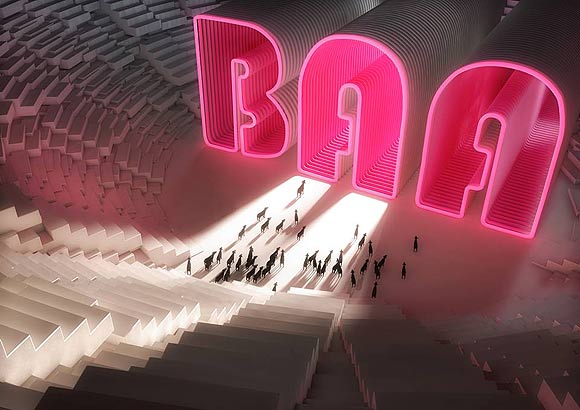
(BAA illustration by Katerina Athanasopoulou)

courtesy : www.cartoonbrew.com 

Balu Mahendra, who made his visuals speak, dies at 74


Balu Mahendra, a pioneer cinematographer feted for his use of natural lighting and film-maker who explored offbeat subjects using realistic portrayals, died at a hospital here on Thursday. Mahendra, who inspired and mentored a generation of directors, was 74. Doctors said he had renal problems and had suffered a heart attack.

Mahendra worked in all south Indian languages and created enduring works in each, as also in Hindi. His best known works include 'Moonram Pirai', 'Veedu' and 'Sandhya Raagam' (all in Tamil), 'Olangal', 'Oomakuyil' and 'Yathra' (Malayalam), 'Nireekshana' (Telugu) and 'Sadma' (Hindi).

Born Balanathan Mahendran to a Tamil family in Sri Lanka, he was drawn to cinema after watching the shooting of David Lean's 'The Bridge On The River Kwai' while on a school field trip. This inspired him to take a course at the Film and Television Institute of India, Pune, where he earned the gold medal in the cinematography course in 1969.

Mahendra entered the film industry as a cinematographer at a time when studios were in decline and mainstream entertainment was being reinvented. He came into the spotlight with 'Nellu' (1974) directed by legendary film-maker Ramu Kariat, who saw his diploma film at the institute and was impressed. 'Nellu' fetched him praise and best cinematographer award at the Kerala state film awards.

"He had a knack of letting his visuals speak several emotions. His visuals could create more impact than any lines in a film," said director K Vishwanath, who had used him as cinematographer for Sankarabharanam.

Mahendra went on to handle the camera for landmark films before graduating to direction. Although he remained within the popular format of film-making, he attempted to subvert genres with his study of character and psychology. His film-making career began with 'Kokila' (Kannada, 1977), which won him the National Award for best cinematography and the Karnataka state film award for best screenplay.

His next venture was 'Azhiyadha Kolangal' (Tamil, 1979), a coming of age story of three boys that the director has said was autobiographical. It did well at the box office and he moved on to 'Moodupani' (1980), a psychological thriller inspired by Alfred Hitchcock's 'Psycho', which was also a huge hit.

But the film that brought him the most acclaim was 'Moonram Piram' (1982), which ran for almost a year in theatres and won him the National Award for best cinematography and best actor award for Kamal Haasan. It also won a host of Tamil Nadu state film awards and Filmfare awards. He remade it as 'Sadma' in Hindi the next year; it did not prove to be successful but attained cult status much later.

Not surprisingly, filmmaker Madhur Bhandarkar posted on social media on Thursday: "Sad to hear the demise of master of innovative camera style, natural lighting, maker of my favourite Hindi film Sadma. Balu Mahendra, RIP." Mahendra went on to make landmark films such as 'Veedu' (1988), which won the National Award for best film in Tamil, 'Sandhya Raagam' (1989), which won the National Award for best film on family welfare, and 'Vanna Vanna Pookkal' (1992), which won the National Award for best feature film in Tamil. Other notable films were 'Marupadiyum' (1993), an adaptation of Mahesh Bhatt's Hindi film 'Arth', and the rip-roaring 'Sathi Leelavathi' (1995), in which he proved that comedy was also part of his repertoire.

His later films - 'Raman Abdullah' (1997), 'Julie Ganapathy' (2003) and 'Adhu Oru Kana Kaalam' (2005) — failed to make much of an impact, which prompted him to turn to teaching. He began the Balu Mahendra Cinema Pattarai in 2007, offering courses in cinematography, direction and acting and mentored filmmakers, such as Bala, Ameer, Sasikumar, Vetrimaaran and Seenu Ramasamy who have won multiple National Awards between them.

But with 'Thalaimuraigal' (2013), a tale of an old man's relationship with his grandson, he sort of redeemed himself, with the movie coming in for praise from critics and audiences alike.

One of his biggest regrets was that though Tamil Nadu had many chief ministers who hailed from the film industry, none of them had taken an initiative to preserve cinema. At many forums, he lamented the lack of a archive for Tamil cinema after the negatives of his film like 'Veedu', 'Sandhya Raagam', 'Marupadiyum' and 'Sathi Leelavathi' were destroyed. It's time one of Mahendra's illustrious students takes up the task of preserving his memory.

Wednesday, February 5, 2014

Baahubali all set to create a VFX splash


Loaded with VFX splendor, Rajamouli's film promises to be a visual extravaganza on an unprecedented scale. Director SS Rajamouli's Baahubali is set to create a new benchmark for visual effects in Indian cinema. The film promises to be a visual effects extravaganza with over 4,500 VFX shots. This is a new record in Indian cinema, surpassing the likes of Shah Rukh Khan's Ra.One and Hrithik Roshan's Krishh 3.

Set in an imaginary medieval realm, the film is loaded with computer generated imagery that promises to blur the lines between real and imaginary. Producer Shobu Yarlagadda reckons the movie will be a 'technical marvel'. "We want to offer the audience a real visual spectacle and have been working in that direction from the outset. It's a period drama that will transport the audience into a world of ancient forts, palaces, epic war sequences and the works. The VFX is going to be the most crucial element in the movie. We have the best national and international experts working on the film," says Shobu.

Srinivas Mohan is working as the VFX supervisor for the movie which has a slew of internationally renowned VFX artistes. Some of the visual effects are being done locally while some are being outsourced to foreign technicians around he world. Considering the scale and quality of the VFX work, the film is tipped to have the highest budget for VFX in Indian cinema.

Buzz is that the budget of the film is a staggering `100 crore. However, Shobu gets a little cagey when talking about the budget. "I cannot comment on that since I don't know about the budgets of other films. It is a very expensive film," he says.

Starring Prabhas, Rana, Anushka and Tamannaah in lead roles, the film is set for a 2015 release across all South Indian languages.


Friday, December 20, 2013

Monday, December 2, 2013

Shah Rukh Khan's Red Chillies VFX likely to work on Salman Khan’s 'Kick'

Srk
 
 
Ever since the release of Krrish 3, Shah Rukh Khan's Red Chillies VFX has been garnering a lot of appreciation for their visual effects in the super-hero flick. Thus, it won't be surprising, if the company is brought on board for several other films as well. Buzz is that Red Chillies VFX may work on Salman Khan's Kick, though there's no confirmation on this front as of now. This Salman Khan starrer film helmed by Sajid Nadiadwala has been in news for a while, it is currently in midst of a marathon shooting schedule in Panvel.
Now with there being a minute possibility of Salman Khan and Shah Rukh Khan working together in a film, at least Kick would be instrumental in getting them together offscreen at least. As of now though, Salman is shuffling between the shoot of Kick and Sohail Khan's Jai Ho. In the meanwhile, Red Chilies VFX, is working on Farah Khan's Happy New Year as well.

Friday, November 8, 2013

NUKE 8 is coming: here’s what you need to know

A new version of The Foundry’s flagship product will be shipping in 2013, with the company announcing at IBC that NUKE 8 is set for launch later this year. The Foundry’s timeline tool for NUKE, HIERO, will also be upgraded to version 1.8 this year.
fxguide speaks exclusively to NUKE Product Manager Jon Wadelton about the changes – see below. But first, just what are the main upgrades in NUKE 8?
Dope Sheet – artists will be able to see and move keys around in the context of a timeline style view. They will be able to see the results and each property of a node accurately displayed in context. The Foundry says the new viewing capability will make working with any scripts that involve time manipulation a much more simple process
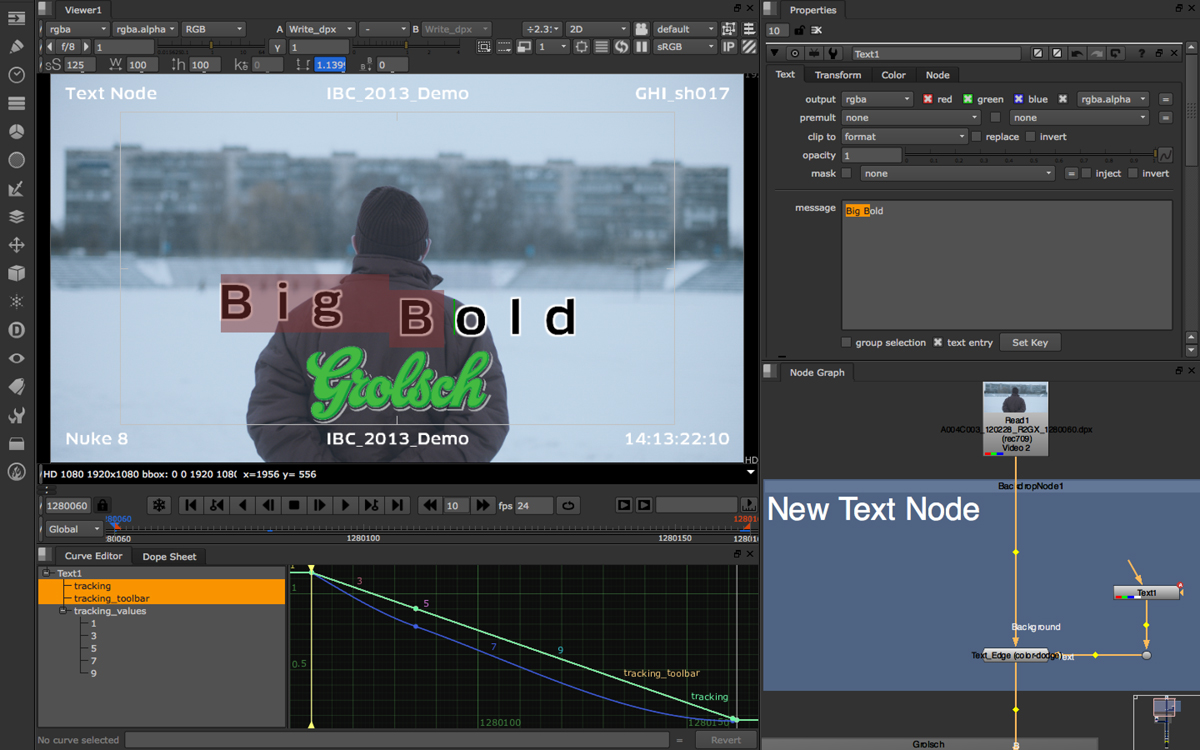
New Text node – lets artists compose, edit and animate directly in the viewer.
Color grading and correction – the NUKE UI has been updated to include an in-panel color wheel to control hue, saturation and value, with an automatic precision mode or optional absolute mode for finer tweaking. There’ll also be a new Pixel Analyser and a Match Grade node.
New scope tools – can be used to analyse the picture like Waveform, Vectorscope and Histogram viewers.
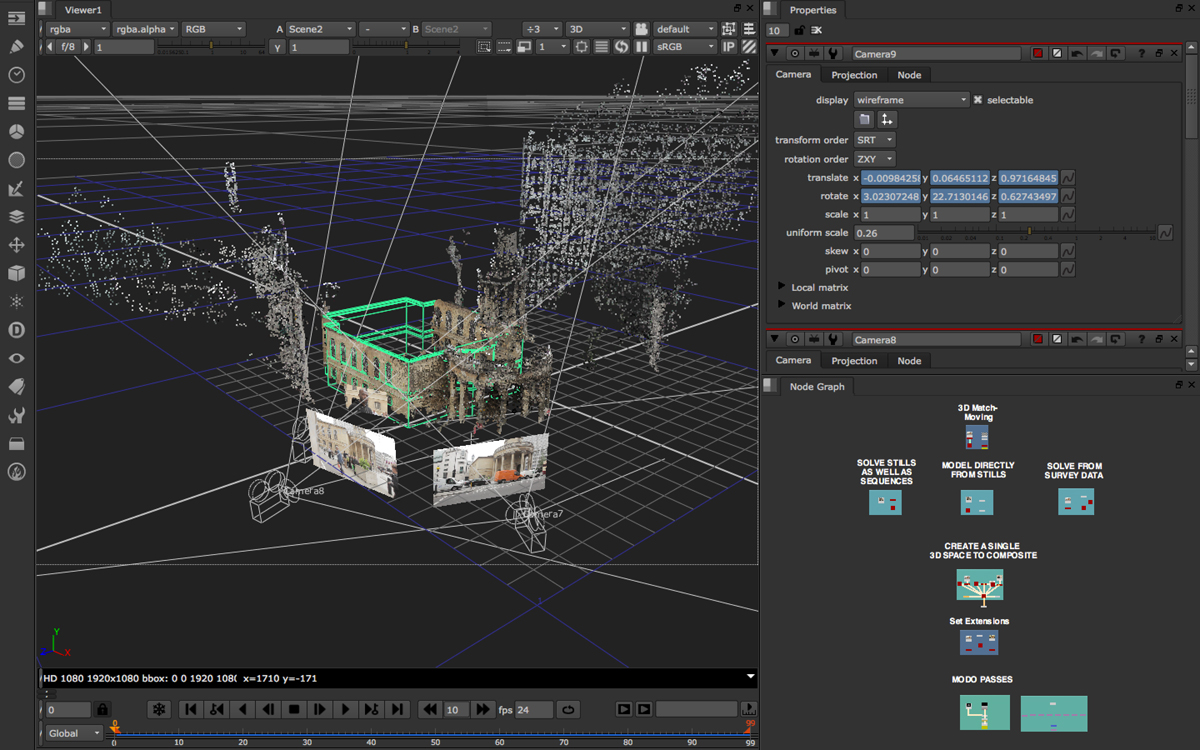
Camera Tracker – this is being updated to add to add to the set solve functionality and will let artists track and solve cameras from reference stills. The Model Builder will also feature UV creation.
Camera Tracker.
Camera Tracker.
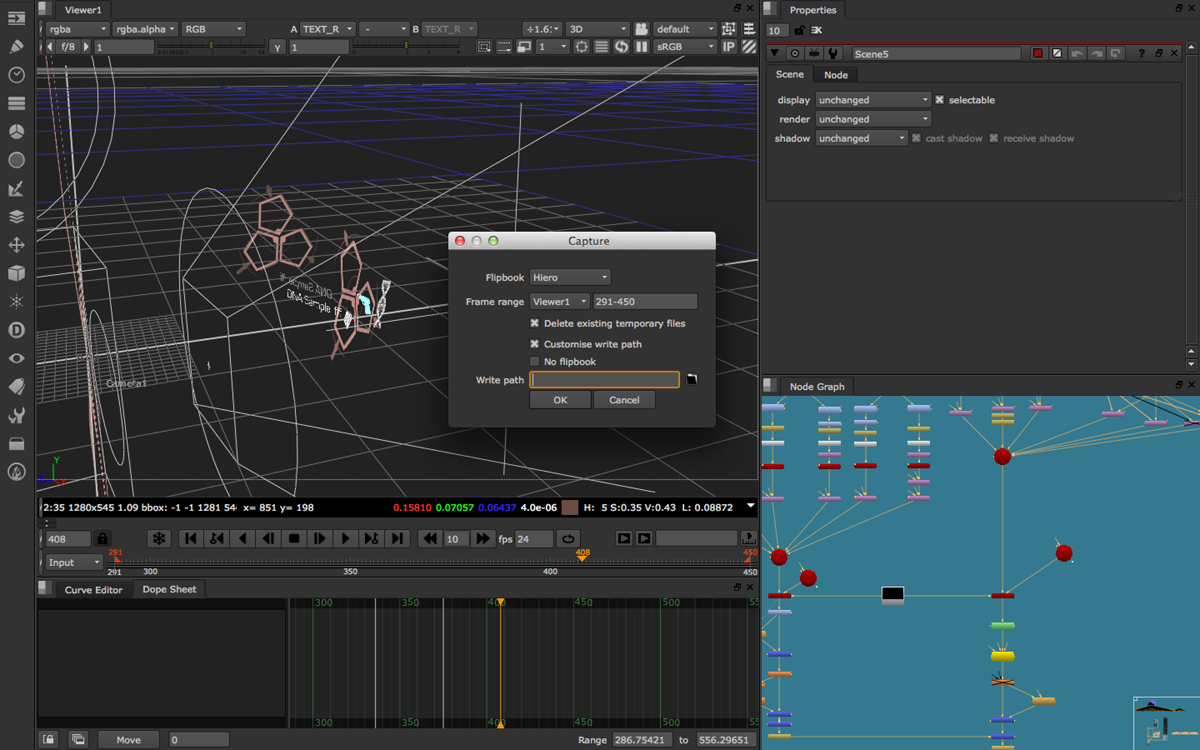
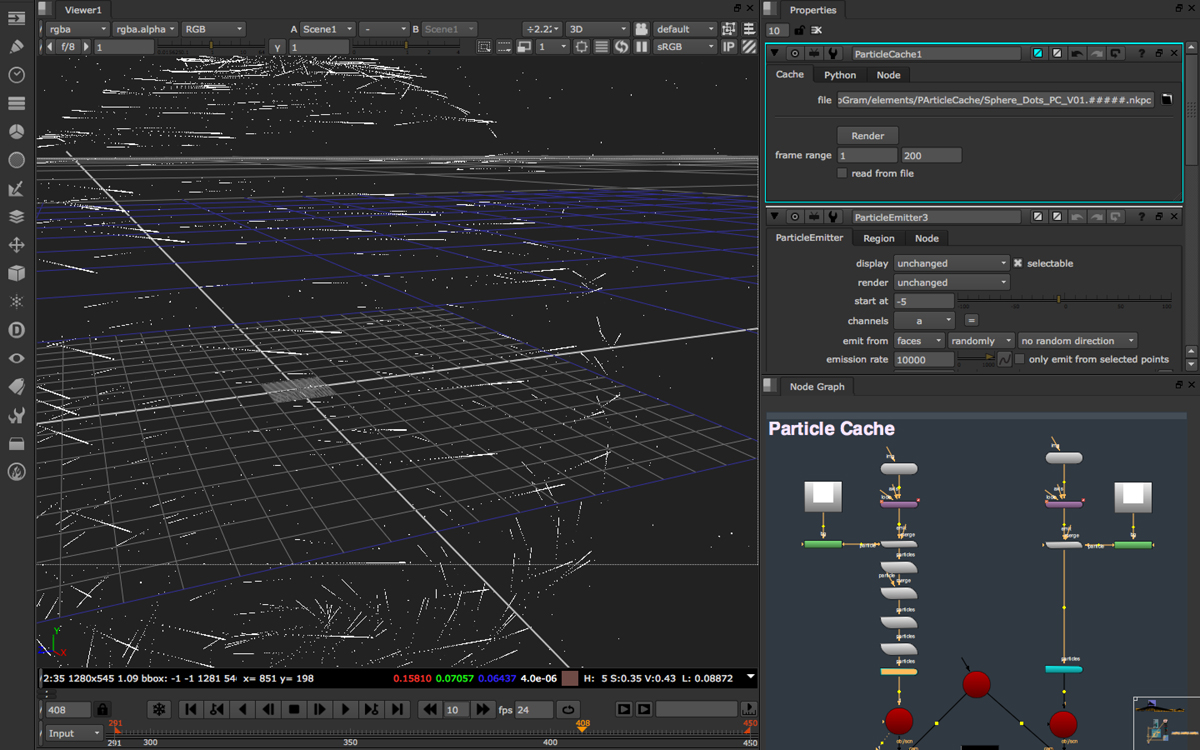
New 3D tools – includes Viewer Capture to allow users to flipbook images from the 2D and 3D Viewer, a new Edit Geo node, a Particle Cache node and the Wireframe Shader node for various visual effects and increased control over projection mapping.
Deep Output to the Scanline Renderer – part of the Deep Compositing workflow.
Open source – OpenEXR 2.0 multi-part image read and write support and Alembic 1.5 support.
In-context help system – this is a new feature for NUKE 8.
Developer tools – developers will be able to write their own image processing operations inside of NUKE using the new Blink Script node, which utilizes the GPU. Developers will also be able to rely on the new Import NUKE function to use NUKE as a module in any Python interpreter, and developers of C++ plugins will be able to output planar data via the new Planar Rendering Framework.
HIERO updates – changes include improved playback performance, color handling controls, and editing audio controls that will give users access to Per Track and Per Item Volume Controls.

NUKE Product Manager Jon Wadelton on NUKE 8

fxg: The Text node – how far will this go in allowing NUKE a greater role in solving graphic design style projects. Is this a stepping stone or do you believe you have a killer text node now?
Wadelton: We are really happy with the capabilities of the new Text tool. We believe it will make most graphic design projects much easier than before. We have common features such as typing in the viewer with cut/copy/paste, per character kerning, per character transform animation, group animation and more. It’s a huge step forward from the previous tool, but of course we never rest in the NUKE team so no doubt it’s still not the final iteration of the tool and it will evolve further in the future.
WireFrame Shader node.
WireFrame node.
fxg: The issue of colour grading has been a big deal for some time now with the Foundry not having a colour grading option. NUKE is aimed more at a shot than an entire edit…so how do you see this being used? Is this a path forward for HIERO – to adopt GPU colour grading?
Wadelton: We’re certainly making NUKE and HIERO work much more closely together. NUKE 8 for instance has adopted all the colour scopes tools from HIERO. We have been playing around with the idea of the reverse of this which we will be showing in our IBC The Foundry Labs demo this week.
As for the updated grading and colour correct tools in NUKE 8, we still see that as something you’d use to match individual elements or plates. We have a much more friendly colour wheel interface for all the colour tools, the new match grade tool, colour analysis scopes and options such as maintain luminance on the hue-correct and more.
fxg: How does the new Match Grade node compare to the old Furnace MatchGrade and/or the match grading algorithms of OCULA?
Wadelton: The new match grade allows you to analyse a sequence to give you a stable LUT that will grade one plate to match another. This differs to the old match grade that could only generate a grade from one frame. The new match grade also has options to export to the LUT to a file (e.g csp, cube etc). The algorithm has also been updated since the original furnace MatchGrade based on research used in OCULA.
ViewerCapture node.
ViewerCapture node.
fxg: The NUKE Camera tracker…any interest in accessing the i/tech (i/tech squared) data from Cooke and other lens companies being shown at IBC? PF Track will access the inertial guidance data and of course lens data/zoom etc
Wadelton: We have discussed accessing more camera metadata with Cooke and some camera manufacturers. This data could be used to lock off or restrict parameters to improve the camera solve. So it’s something we’re looking into for the future.
fxg: How much will the Particle Cache node speed up rendering? Have you benchmarked it?
Wadelton: The particle cache can considerably increase render speed and increase interactivity in a heavy script. The node caches out the particle simulation to disk. So once the artist is happy with the simulation it can be committed to disk eliminating the simulation time from overall render time.
Depending on how heavy the simulation is, this can save considerable time. It also really helps in the render farm situation where independent render slaves are each rendering a frame each. Without the cache these slaves would need to ‘run up’ the simulation to the frame that they are rendering, with the cache this is not necessary.
Above: NUKE Product Manager Jon Wadelton outlines the new features in NUKE 8.
fxg: Can you expand on what you can now do in the EditGeo node that you could not do before please?
Wadelton: The EditGeo node is a new node that allows you to move vertices and faces of geometry flowing down the node graph. It can save a round trip to a 3D application when your geometry is not quite right. For instance you are doing a projection and the geo and some verts are not quite in the right position. With the EditGeo you can quickly correct this in the comp.
TextNode.
TextNode.
fxg: Could you explain for people who don’t know what the Planar Rendering Framework is please?
Wadelton: It’s a new API for C++ developers who need to develop Planar or Tile based rendering plugins. NUKE is a scan-line based render system but not all algorithms fit to this style of rendering. Developers who need to render in tiles or planes can use the API rather than writing their own system to convert from scan-lines to tiles. The advantage for developers is much reduced complexity for implementing tiled rendering along with NUKE taking care of all the memory management. NUKE internally now uses this API for tile based rendering such as OFX, Blink based nodes and EXR files that are compressed into tiles. For the artist this will give them speed increases, reduced memory use, and more stability.
fxg: Could you discuss the adoption and success for Deep Comp pipelines that has lead to the scan-line Deep Output please?
Wadelton: Deep comp is becoming more widely used across film pipelines worldwide especially since more renders are starting to support the Deep EXR 2.0 format. A good example was MPC Vancouver’s work on Life of Pi for which they won them the VES outstanding compositing in a feature motion picture last year. That sort of shot would have been very difficult and time consuming without the deep compositing tools at the artist’s disposal. Part of the feedback we’ve had is that it would be great to integrate NUKE 3D elements into an existing deep scene, whether that be the NUKE particle system or just simple 3D elements to act as holdouts. That’s what we’ve added in NUKE 8. The NUKE internal scan-line render can now produce deep data directly to integrate with your existing deep elements.
ParticleCache.
ParticleCache.
fxg: How extensive has the beta process been? When can people download NUKE 8?
Wadelton: We have been in closed beta for several months and the feedback has been really positive. We will be opening this up very soon.
fxg: The Dope Sheet is a great advance – can you discuss the user feedback – from Beta or other – that shaped its development please?
Wadelton: NUKE has always had powerful procedural ways of moving and retiming elements around in time. The feedback we had was that you were very much shooting in the dark as to where all your elements had been moved to, so you could get lost fairly easily. The new dope-sheet solves this by showing all the keys and all the elements at their time shifted locations in a context sensitive way. So if you view keys before a node that moves them in time, you see them at their original time. If you view after the time manipulation, you also see them where they’ve been shifted too.
Courtesy : www.fxguide.com 

Wednesday, October 23, 2013

Manna Dey: Thank you for the music


Prabodh Chandra De, better known as Manna Dey, one of Bollywood's best-loved voices, died in Bangalore after a prolonged illness. The voice behind Laga chunri mein daag from Dil Hi To Hai, Ae Meri Zohra Jabeen from Waqt, Yeh Dosti from Sholay, Babu Samjho Ishaare from Chalti Ka Naam Gaadi and other memorable Bollywood hits, Manna De celebrated his 94th birthday this year and was awarded West Bengal's prestigious Vishesh Maha-Sangeet Sammaan in April. 
Manna Dey was born on May 1, 1919 in Kolkata. He began singing while still in school and stood first in various inter-college competitions while at Kolkata's Scottish Church College.Manna De took his first formal music lessons from his uncle Krishna Chandra Dey, who was a music director and composer, and began his Bollywood career as his uncle's assistant in 1942.
He worked independently as a music director for various Hindi movies before making his singing debut with the movie Tamanna in 1943. His very first mentors were Ustad Aman Ali Khan and Ustad Abdul Rahman Khan from whom he took lessons in Hindustani classical music.
One of the greatest playback singers in Indian cinema, Manna De sang in many Indian languages including Hindi, Bengali, Assamese, Gujarati, Malayalam, Punjabi, Kannada and Bhojpuri. He partnered with Mohammed Rafi, Kishore Kumar, Lata Mangeshkar and Asha Bhosle for several hit duets. He also formed successful pairings with actors Raj Kapoor and Rajesh Khanna, and composers Salil Chowdhury, Hemant Kumar and Laxmikant-Pyarelal. 
Manna De ruled the playback music scene from the 1950s to the 1970s. Some of his greatest hits are: Laga chunri mein daag (Ae Mere Pyaare Watan (Kabuliwala, 1961), Zindagi Kaisi Hai Paheli Haai (Anand, 1970), Poochho Na Kaise Maine Rain Bitaayi (Meri Surat Teri Aankhen, 1963), Chalat Musafir Moh Liya Re Pinjare Wali Muniya (Teesri Kasam, 1966), Kaun Aaya Mere Mann Ke Dwaare (Dekh Kabira Roya, 1957), Kasme Vaade Pyaar Wafa Sab (Upkar, 1967) and Dil Ka Haal Sune Dilwaala (Shree 420, 1955). He sang Mehmood's part in the duet Ek Chatur Naar (Padosan), Raj Kapoor's part in Pyar Hua Ikrar Hua (Shree 420) and Yeh Raat Bheegi Bheegi (Chori Chori), and Pran's famous song from Zanjeer, Yari Hai Imaan. 
Manna Dey continued to sing at concerts and in Bengali cinema long after he had retired from Bollywood. Manna De was honoured with the Padma Shri in 1971. In 2005, he received the Padma Bhushan, India's third-highest civilian honour. He was also presented with the prestigious Dadasaheb Phalke Award in 2007 and received the Filmfare Lifetime Achievement Award in 2011.


Source: BBC India

Saturday, October 12, 2013

"redchillies.vfx Team has delivered 1500 VFX shots in "Chennai Express"..


redchillies.vfx”team has delivered 1500 VFX shots for Rohit Shetty’s Chennai Express.This Shahrukh Khan starrer movie that grossed 410 crores and has become highest grosser in Indian Cinema

The team created many seamless complex CGI transitions complimenting the scenes and storyline of the film. So what was Rohit Shetty’s vision for the VFX of Chennai Express?  Keitan Yadav, COO of redchillies.vfx shares with Animation Xpress.com, “Rohit’s vision for the movie was to make the film look stunningly beautiful, rich & vibrant with breathtaking scenery, skies and colors.He wanted natural pleasant feel with very distinct feel to two villages. With magic hour environment at places and full open blue skies during journey the experience was enhanced. A lot of beautification has gone into songs like “Chipak Chipak ke” and “Titli”, informs Keitan

Haresh Hingorani (Harry), Chief Creative Officer, redchillies.vfx, adds here, “Rohit wanted us to instill mood transitions, instead of direct cuts or dissolves between shots. We then pre-visualized these sequences, and designed the transition to enhance the storyline, which has come out extremely good and being appreciated by the audience. 


The render time for certain VFX shots in the movie went up to 10-15 hours per frame as many shots were worked on 4K resolution and quite complex due to vegetation and waterbodies added.
Another sequence where tranquil beauty of a setup was enhanced is train coming to a stop at a waterfall. Landscape enhancement along with waterfall took this scene to a different level. This was shot during the dry season with mostly dry vegetation and very less waterfall due to off monsoon time.
Adding more Harry continues, “Here the waterfall was enhanced and 70% of greenery re-created in CGI, which took around 2 months to finish. One more shot was the 360 degree chopper shot in which around 80 percent of shot was created in CGI; the shot was stabilized, we added greenery and flowing streams to make the shot look spectacular.”

Also, the team created set extensions for vidamba village “We received a footage having 30 percent of houses and the rest had to be generated with CGI.” Highlights Harry
The prime challenge for the artists was to create heavy transitions seamlessly and realistically. It took around four months for the team to work on the different sequences of the movie.
Gradual transitions of journey progressing through the day made the train sequences more exciting, which were completely shot against green screen in a studio


Transition of a camera pulling out of the moving train through the window and rising high had multiple layers. This took lot of effort and artistic fineness to seamlessly integrate into one move combining live and CGI elements seamlessly.


Climax of the film had a hand to hand combat where props used were dangerous for actors, adding vfx helped keep the fight natural, it also has a burning stove being tossed around and finally concluding into a huge blast

Scenic shots like the train pulls in to a station in early morning; to transitions like the day turning into evening via mobile phone; to a transition where the train enters a tunnel in the evening and the headlight of the trains transforms into a beautiful full moon revealing the landscape at night where the train is passing over a bridge on the river are some more master shots created by redchillies.vfx using visual effects skills.” asserts Keitan. The redchillies.vfx team received interesting reviews on entire movie as people are grateful for showing India so beautiful and never before seen scenery.

Source: Animationxpress


Thursday, October 10, 2013

A Tribute to Srihari – The Multifaceted Actor!


Raghumundri Srihari, better known as Srihari by Telugu Film Industry was one of the most versatile, captivating and multi-faceted actors the film world had. Beginning his career as a stunt master, he evolved eventually to one of the highest paid character actors of Telugu Film Industry. His life speaks of hard work, dedication and tremendous talent throughout his career.
Srihari started off with negative roles in Tollywood, but later shifted to Comedy, Sentiment, Aggression and even Heroism. Nobody can forget the laughter he generated in films like Hello Brother, where he played a Singapore returned relative of the heroine (Soundarya) or Bavagaru Bagunnara, a funny proud villager who falls for the heroine (Rambha).  As a hero he was wonderful in roles showcasing sincerity, revenge, anger in films like Ayodhya RamaiahSimhachalam and Hanumanthu.
While continuing his tenure as Hero during post 2000s, he never failed to adorn memorable character roles such as the considerate brother in Nuvvostanante NenoddantanaDheeKing or even the recent Jr.NTR starrer Brindavanam. However, it was S.S.Rajamouli’s Magadheera which took his talent to new levels with Sher Khan/ Solomon character and people admired the amazing talent of Srihari. He recently made a Bollywood entry withToofan as a villain opposite Ram Charan.  Srihari was best known for his powerful dialogue delivery and ability to excel in any sort of emotion at ease.

Despite being a talented actor, Srihari was so human at heart that established Akshara Foundation in the fond memory of his lost daughter. He was a great philanthropist and adopted four villages near Medchal area for caretaking.
Srihari died of Liver Cancer in Lilavati Hospital, Mumbai today. His sudden demise today has been a shock to the entire Telugu Film industry and Film lovers. Telugu Film Industry not only lost a great actor, but also a wonderful human being with philanthropist values and ideals. Though he is physically not present in this World, his films and performances along with the good work he did off the screen will always be remembered. iQlik Movies offers deep condolences to his family and remembers the wonderfully talented character actor. 

WHITE HOUSE DOWN: Martyn Culpitt (VFX Supervisor) & Mark Wendell (CG Supervisor)


Martyn Culpitt started his career in visual effects with the LORD OF THE RINGS trilogy, then he worked on films such as VANTAGE POINT, INVICTUS or THE GREEN HORNET. He joined Image Engine in 2012.
Mark Wendell is in VFX for over 20 years. He worked on films like SHREK, ALICE IN WONDERLAND, SPEED RACER or PROMETHEUS.
What is your background? 

Martyn Culpitt – Visual Effects Supervisor // I have been working in the Industry for over 20yrs. I initially started my career in film set construction at Marmalade Vision in Wellington, New Zealand in 1992. I soon realized I was more interested in the digital world so changed my job and worked my way through the editorial department of the company, becoming Senior Editor within the first few years. Following my interest in visual effects, I moved to the TV, film and visual effects industry as a 2D artist working on films such as THE LORD OF THE RINGS trilogy, TROPIC THUNDER, TWILIGHT, ANGELS & DEMONS, INVICTUS, SALT and THE GREEN HORNET. I was asked to join Image Engine to work as the Compositing Supervisor for R.I.P.D. in 2012. I had always wanted to work on creature films and it was a great opportunity to expand my experience even further.
Since I started in the industry, I have always tried to push my work and keep learning every project, my goal was to one day become a Visual Effects Supervisor. When I was given the opportunity to work with Roland and the Team at Uncharted Territory as Visual Effects Supervisor on WHITE HOUSE DOWN I was thrilled.

Mark Wendell – CG Supervisor // I’ve been in the vfx and animation biz for over twenty years, wearing many hats, including CG supervision, lighting, compositing, pipeline, fx, tools development, layout, and I even have an ‘animation supervisor’ credit! That’s one of the things I like about CG supervision, frankly, is that it’s an excuse to do lots of different jobs throughout the pipeline. I started in this business back when there weren’t any schools for learning CG, and in fact I have a biology degree, so everything I know about CG was self-taught and learned on the job.
How was the collaboration with director Roland Emmerich?

Martyn Culpitt – Visual Effects Supervisor // Our collaboration with Roland was a very smooth process. Working through Marc and Volker we had direct feedback as soon as we needed it, so there was no wasting time. Roland always gave concise feedback and direction, but he would listen to us and appreciated our ideas, which helped us take the shots to the highest level we could together. It did honestly feel like a collaboration rather than Roland just giving notes.

What was his approach to the visual effects?

Martyn Culpitt – Visual Effects Supervisor // Roland, Marc and Volker had done a lot of previs for the film; most films do as it saves a lot of time in the end. On WHITE HOUSE DOWN, It felt like Roland took it to the next level where he would sculpt and design each camera and shot in previs and even further with the team at Uncharted Territory once they had completed filming, before passing it off to us to create the final shot. By the time we started working with them they had pretty much locked down every camera angle and shot. This gave us time to work on the more important details of each shot and given the time constraints we had this was ideal.


 How was the collaboration with Production VFX Supervisors Volker Engel and Marc Weigert?

Martyn Culpitt – Visual Effects Supervisor // We had a great collaboration with Marc and Volker, it felt like right from the start we were very much on the same page and our goals we very similar. ‘Make the shots as best and as realistic as we can within the time frame we have’. The White House is such an iconic building and has such a unique look to it so every detail had to be exact and photo real. The goal as always in VFX is to make the work we do as invisible as we could so the viewer isn’t taken out of the movie. I think working with Marc and Volker we were able to achieve this on every level. We had a lot of shots to delivery in a very compressed time frame. We really needed to get feedback and direction as early as we could in the process so would send very early versions of our shots to Marc and Volker, rather than waiting to polish the shots. They really appreciated us doing this as it gave them a lot of creativity at an early stage. This enabled us to get a lot more done and to make sure the shots worked when they were cut into the film. We would then push the shot through the pipeline and get it back as fast as we could to get final notes addressed


What have you done on this show?

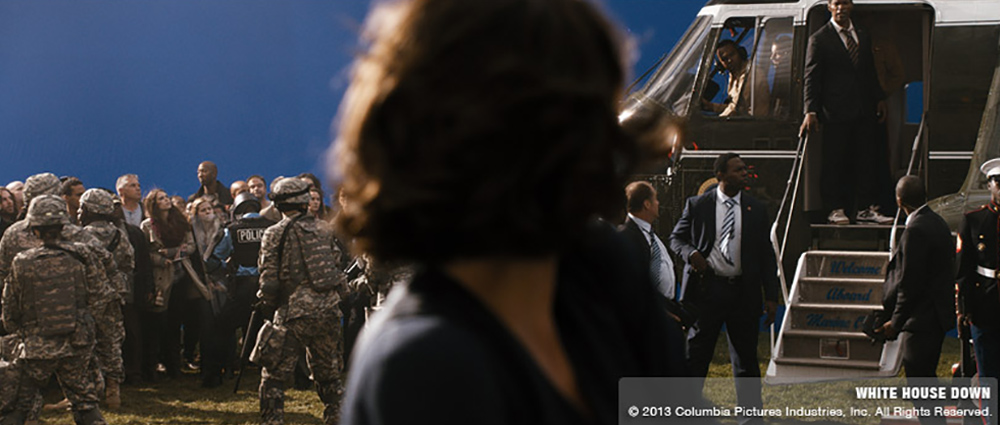
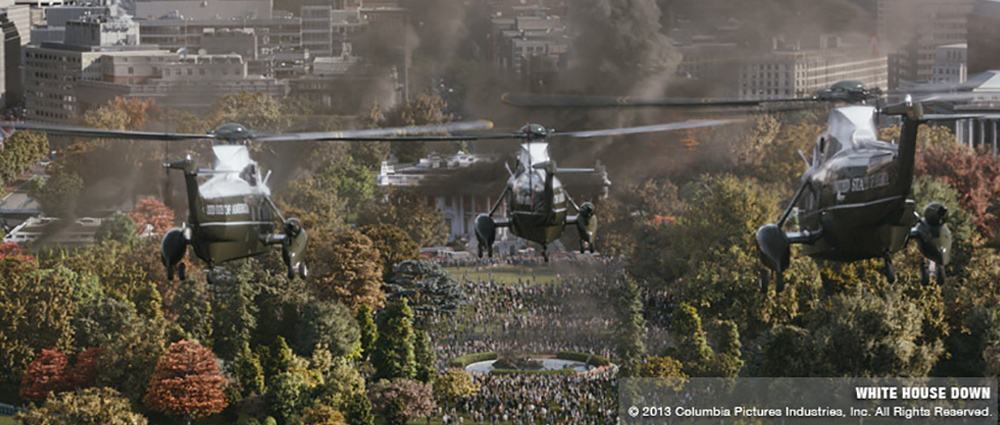
Martyn Culpitt – Visual Effects Supervisor // We created nearly 100 shots. The shots were in the Takeover and the Aftermath sequences. The Takeover sequence is just as the terrorists took over the White House and the national guard, reporters and civilians start to congregate on the white house lawn. In the Aftermath sequence our work ranged from blue screen plates, where we had to add CG White House grounds and the Washington Monument, to our biggest shots where we had to create full CG Environments for both the White House and surrounding Washington City with jets and helicopters flying around.

How did you create the three helicopters?

Martyn Culpitt – Visual Effects Supervisor // The Initial helicopter asset was created by Luxx Studios and handed over for us to use. We had to do extensive work to bring it into our pipeline and be able to use our shaders and the textures with our renderer 3Delight. We also had to re-rig the Helicopters so that we could make the landing gear and all other aspects of the chopper move the way we wanted it to.

Mark Wendell – CG Supervisor // Amusingly, we were looking into generating some organic variation between the three helicopters, when we did a bit of research and found out that they are “supposed” to be identical. The US government maintains the fleet of presidential choppers in pristine and identical condition, and scrambles their formation upon takeoff, in order to hide the president’s location. Apparently this is referred to as the presidential “shell game”, but for us, it was an excuse to use the same asset for all instances of the chopper. Seriously, though, with minor variations in things like rotor speed, everything looked great.


Can you tell us more about their animation and the renders?

Martyn Culpitt – Visual Effects Supervisor // The animation was based on the actual previs. Roland, Marc and Volker did a lot of work early on to make sure they had the movement and look of the each shot. We strayed a little from this but most of our animation is based on the previs movement. Obviously once you have that base movement you then add and tweak the subtleties of the movement so that it feels right, once you get all the other assets and environment work done. We used 3Delight as our main renderer with full rayracing. We ran into some issues with noise in our renders and the guys at 3Delight were great about responding quickly tweaking and adjusting the renderer and our shaders to get it fixed up and looking great!
Mark Wendell – CG Supervisor // We’ve been experimenting with a fully ray-traced physically plausible approach to shading, and WHITE HOUSE DOWN was the second show that proved to us that this is the way forward. We worked closely with the folks at DNA Research to solve some noise artifacts and memory consumption issues early on with 3Delight, but in general this was a great experience for us, and we’re continuing to refine our shading workflow in this direction.
What was the most challenging aspect about the helicopters?

Martyn Culpitt – Visual Effects Supervisor // The biggest challenges we faced were getting the reality of the light and environment reflections, and the movement. Each shot we had to be tweaked so that we got the photo-real look we wanted.

Can you explain in detail about the White House creation and its environment?

Martyn Culpitt – Visual Effects Supervisor // Having to create a fully CG environment is one of the hardest things to do in VFX. Especially with such a well known building as the White House, its surrounding grounds and Marine One helicopter. We initially received assets from Method, Luxx, and Prime Focus World, each of which needed extensive work to be able to use them in our pipeline. We spent a lot of time re-linking and adjusting textures, then building our own shaders so we could get the matching look of the assets. Once we had the match, it was then up to us to push them around until we got the approved look that Roland, Marc and Volker were happy with.
Method gave use the White House and the Tree assets. The White House is such a hard thing to create; it honestly feels like the paint on the White House has its own unique quality, it feels like it emits light. The shadows and ambient occlusion plays very differently than any other building. This is very difficult to emulate in CG and especially hard to match to references. We had to do a lot of manipulation to get it to look exactly the way we wanted.

The Environment had over 800 trees, each having many hundreds of leaves, which had to interact with real world forces and be photo real. Having to render this amount of data definitely has its own hurdles that we had to work around. We had to create a very specific tree shader so that we got the same look as our tree references and have the light interaction that we needed to get the photo real quality that Marc and Volker so wanted. Spending the time and creating this shader early on was the key to getting the shots to look so good. Prime Focus gave us some of the people assets, each of which needed extensive work to get them integrated in our pipeline and renderer 3Delight.
Mark Wendell – CG Supervisor // The amount of data shared from Method Studios in particular was huge. The nice thing about the data sharing, though, was that they gave us everything, including not only the final tree models and textures, but all the SpeedTree scene files used to generate those models. That gave us the flexibility to adjust things like wind parameters and geometric details specifically for our shots. This was important for us, since most of our shots were on the south lawn of the White House, while most of Method’s shots were at other locations, so they never needed to add the detail to the south lawn trees that we required. By having the original scene files, we had everything we needed to ‘detail up’ for our shots fairly quickly.
We learned a lot about raytracing massive amounts of geometry on this show, taking advantage of instancing, and using a fairly simple shading model. One of our shading TDs, Daniel Dresser, came up with a nice way to add color variation to tree instances across the parklands at render time, and then any further variation was managed in comp since we provided them with unique hue based ID mattes for each tree.


Can you tell us more about their animation and the renders?
Martyn Culpitt – Visual Effects Supervisor // We used Houdini to create the smoke passes needed for each of our shots. Some of the shots had over 10 different sims to make sure we had the right movement and feel for each element. Some of these would take many hours to render as there was so much detail needed, especially in the close up shots around the balcony of the White House and the windows. It is very hard to create such subtle detail in the smoke, it took us a lot of time and iterations to get the exact feel we wanted. Then we had to use the many passes and AOV’s to get the final look. For the fire we used elements that we had shot and these were comped in.


How did you get your references for the White House?

Martyn Culpitt – Visual Effects Supervisor // Marc and Volker had done extensive work in capturing as much of the White House and Environment as they could. They filmed both from the air and on the ground but there we specific limitations of the area, as it is obviously very protected. So some of the references and textures we had to do quite a bit of paintwork and clean up on to use them for our shots.
Can you tell us more about the crowd creation?

Martyn Culpitt – Visual Effects Supervisor // Prime Focus sent us their assets for the National Guard, Police, civilians and reporters. We spent a lot of time tweaking for our rigging, pipeline and renderer 3Delight. We also created many props and different little pieces for each person to be different. In some of our biggest shots we had over 6000 people, this was itself an issue that we had to figure out when it came to rendering. Using our internal layout system helped us to be able to do this.
We created a rig right at the start so that it could be easily ported over to each different type of person and be adjusted so it would work efficiently. We used our own internal layout system to create the actual crowds and to give us the randomness that we needed. We created a way to apply many different items of clothing, skin color, props etc to give the crowd variation and to adjust where needed. We are able to save a lot of time accessing only a small part of the crowd and tweaking it with out having to adjust the whole crowd at once.

All the motion was applied using ‘motion capture’ that was adjusted and tweaked as needed. Most of it was supplied from Uncharted Territory. But there were cases where our animators would hand animate the crowd so that we got the motion we wanted.
We used Houdini to create the smoke passes needed for each of our shots. Some of the shots had over 10 different sims to make sure we had the right movement and feel for each element. Some of these would take many hours to render as there was so much detail needed, especially in the close up shots around the balcony of the White House and the windows. It is very hard to create such subtle detail in the smoke, it took us a lot of time and iterations to get the exact feel we wanted. Then we had to use the many passes and AOV’s to get the final look. For the fire we used elements that we had shot and these were comped in.

What was the biggest challenge on this project and how did you achieve it?

Martyn Culpitt – Visual Effects Supervisor // The biggest challenges we had were creating such a large crowd and having to render it with our full Environment. The other headache we had was having to create two versions of the White House, one damaged and one pristine. The crowds had their own unique issues that we have now solved after this movie. A lot of it had to deal with so many individual people so we created tools to access individuals or selected pockets without having to open the entire crowd system. It made huge differences both for workflow and also when it comes to render time.

The White House was the hardest asset to create and work with as we had two versions of it in the pipeline at one time. We created the pristine version and then had to destroy/damage it piece by piece. This was done in both the asset and also using matte painting work to fully destroy it. The issue is that the pieces we destroyed were also linked to the pristine version so we had to be very careful not to break the links between each and keep them separate
Was there a shot or a sequence that prevented you from sleep?

Martyn Culpitt – Visual Effects Supervisor // Mainly the Crowds and the Trees, but once we figured out the shaders and the way we could handle that many people then I was finally able to take a deep breath

What do you keep from this experience?

Martyn Culpitt – Visual Effects Supervisor // Working with Uncharted Territory, especially Marc, Volker, Julia and Roland was a fantastic experience and would love to do it again. We worked well together and I think we were able to achieve some fantastic work.

Mark Wendell – CG Supervisor // This show gave us the confidence to commit one hundred percent to physically plausible ray-traced shading, as the advantages both in terms of visual realism as well as lighter time really paid off on this film. Also, based on our experience with building large environments on films like White House Down and Elysium, we’ve invested development effort into expanding our toolset for setting up and rendering complex environments. While the parklands in WHD had hundreds of trees and took a bit of effort to get final renders through, we can now render tens of thousands of trees, in a fraction of the memory and render time of previous shows, using our updated tools.
 
What are the four movies that gave you the passion for cinema?

Martyn Culpitt – Visual Effects Supervisor //
BLADE RUNNER
ALIEN
THE MATRIX
STAR WARS / THE EMPIRE STRIKES BACK

Mark Wendell – CG Supervisor // For me, it was really just one film… 2001: A Space ODYSSEY. It created an incredibly realistic future in space, and made me aware of how important research and thoughtful art direction are when it comes to science fiction. I had the chance to discuss and screen the film with Doug Trumbull recently, and that was one of my childhood dreams realized. I still study the docking sequence to this day for the amazing composition and shot design. Beautiful work.


Source: Art of VFX